

























X-CHASE
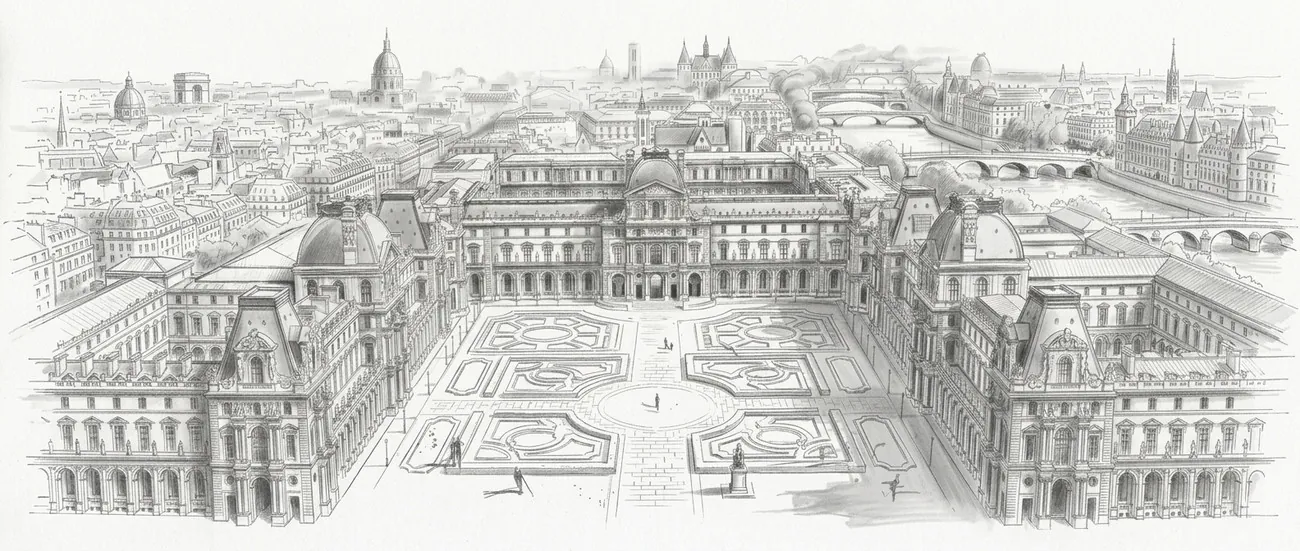
Pencil drawing of a great museum court seen from above, the frontispiece of the Long Gallery
The wax seal of the House of X-CHASE

Heritage · Exhibition XC·LG·EX-01

The Long Gallery

A history of financial institutions in fifty-six plates: the instruments, the crises, the people and the houses from which modern finance was built.

From the House of X‑CHASE · Office of Institutional Intelligence · Second edition, reviewed October 2026

PlatesFifty-six, in eleven rooms
SpanFrom Athens, c. 400 B.C., to the present
WingsInstruments, the System, the People
Each plateThe record, the sources, and the House’s reading

About the Gallery

Every instrument in modern finance was once an object a person could hold. This gallery returns them to the hand.

In the great houses of England and France, the long gallery was the room where a family hung its portraits and walked among them. It was a record of who had built the house, who had kept it, and who had nearly lost it. The House of X‑CHASE has built one for finance.

The Long Gallery is a research exhibition in fifty-six plates. It follows the instruments, mechanisms, people and institutions from which modern financial systems were assembled: the money-changer’s table in Athens, the bill of exchange, the first share, the manias, the information networks, the walls around client money, and the private houses that have lasted for centuries. Each plate is an essay written for the exhibition, and in the rooms of the Sitters and the Houses each essay is accompanied by a modern watercolor study. Every plate closes with the House’s reading: what the episode means for anyone designing, launching or governing a financial institution today.

X‑CHASE designs, launches and manages financial institutions. Studying how earlier institutions were built, and how they failed, is part of that work rather than an ornament to it.

In brief

Each plate opens with one sentence that states the essential fact.

The essay

The history, told from the record, with dates, places, names and sources.

The House’s reading

Each plate closes with what the episode means for anyone building an institution today.

Ways through the Gallery

Four routes that cross the rooms, and three instruments for finding a way through them.

Plan of the Gallery

Three wings, eleven rooms, fifty-six plates. Each plate has its own page.

Wing I

The Instruments of Exchange


Before there were institutions there were objects: a table, a bench, a notched stick, a letter, a coin. This wing follows money from the furniture of the ancient square to the first stock market, through the two winters in which it lost its mind, and ends among the crowds that stood watching.

Room I

Origins


Finance began as furniture. The table, the bench and the tally stick established custody, credit and the record, and the words bank, bankrupt and stock still carry their shapes.

Room II

Instruments


Three inventions did more for capital than any single fortune: a way to record it, a way to move it, and a way to measure it against something solid.

Room III

The Cabinet


A small case of instruments rather than institutions: what capital looked like in the hand. The third card is left open on purpose.

Room IV

Mania


Markets have never needed a new invention to lose their heads. A flower, a debt conversion and a rumor have each been enough. The third plate shows how a standard of conduct answered them.

Room V

The Crowd


The rooms before this one show objects and mechanisms. This room shows the people standing around them: not the named sitters of Room X, but the crowd, which is never wrong about how it feels and often wrong about what to do next.

Wing II

The System


Once capital could be recorded, moved and traded, it needed rules, walls and channels. This wing covers the information networks that set prices, the perimeter every institution draws around client money, the mechanisms of modern crises, and the three figures by which the House understands its own work.

Room VI

Information


Three centuries spent shortening the distance between an event and its price. The distance is now close to zero, and the advantage has moved to whoever owns the connection.

Room VII

The Perimeter


Three studies of the line around an institution: what grants it, what it must keep on the far side of that line, and what it does when everyone arrives at once.

Room VIII

The Reckoning


Three mechanisms from the last twenty years, examined in the same manner as the rooms before them. The apparatus did not stop being built in the twentieth century. It only became harder to see.

Room IX

The House


Three figures that are not historical. They are how this House understands its work: the arch, the pyramid and the escapement.

Wing III

The People


The long galleries of old houses were built to hang portraits of the people who made them. This wing does the same for finance: fourteen sitters who built, broke, reformed or outlasted its machinery, and fourteen houses that have survived, or not, for between one and five centuries.

Room X

The Sitters


Fourteen people who built the machinery in the earlier rooms, broke it, wrote its rules, moved faster than it, trained the next generation, or refused to play by it. The studies are modern watercolors made after surviving likenesses; the sitters are not modern.

Room XI

The Houses


Fourteen institutions, from a public pawn bank founded in 1472 to a Zürich house founded in 1890, and the choices that kept them alive or ended them: liability, succession, size, legal form and conduct.

A Living Gallery

The Gallery acquires one new plate each month, and four times a year it sets one of them on a dinner table.

The editors

The Long Gallery is written, reviewed and maintained by the Office of Institutional Intelligence of the House of X‑CHASE, which also publishes the Keystone series of studies. Every plate is reviewed against its sources before each edition. The current edition was reviewed in October 2026.

The Gallery is also printed as a numbered catalog, limited to one hundred copies, each sealed by the House.

The Long Gallery

Acquisitions


The Gallery is not finished. It acquires one new plate each month, and records every change in a register.

The register

August 2026

First editionThe Long Gallery opens with its three wings and eleven rooms.

October 2026

Second editionAll plate texts rewritten and expanded and the facts reviewed. Each plate receives its own page, its sources and the House’s reading in practice. Added: the houses at a glance, the timeline, the atlas, four routes through the gallery, the questions and the glossary.

In preparation

The Gallery acquires one new plate each month, and four times a year it sets one of them on a dinner table.

  • Plate 59

    The Assignat

    Paris, 1789–1796

    Paper money secured not on metal but on land confiscated from the Church. It is the first candidate named on the open card in the Cabinet, and the clearest case in the record of a currency that was well secured and still failed.

    Expected · November 2026
  • Plate 60

    The Bank of Amsterdam

    Amsterdam, 1609

    A municipal exchange bank that let merchants settle by transfer in a unit of account more reliable than any coin in circulation. Its bank money traded at a premium to coin, the agio Adam Smith described in 1776.

    Expected · December 2026
  • Plate 61

    Bardi and Peruzzi

    Florence, 1340s

    The two largest banking companies of their age, brought down in the 1340s with loans to a king who would not repay. Among the great early failures of sovereign lending, and a lesson the Medici structure later reflects.

    Expected · January 2027
  • Plate 62

    Overend, Gurney

    London, 1866

    The bankers’ bank of the City, whose failure on 10 May 1866 produced the panic of the following day, from which Bagehot drew the rules of Lombard Street.

    Expected · February 2027
  • Plate 63

    The Imperial Ottoman Bank

    Constantinople, 1856 and 1863

    A privately owned bank, founded in 1856 as the Ottoman Bank with British capital and renamed in 1863 when French capital joined, that served as the state bank of an empire. A study in what a central bank is when it is not owned by the state.

    Expected · March 2027
  • Plate 64

    The Imperial Bank of Persia

    Tehran, 1889

    A British-chartered bank with the right to issue the notes of Persia. Its successors carried banking across the Gulf in the twentieth century.

    Expected · April 2027
  • Plate 65

    The Eastern Bank in Bahrain

    Manama, 1920

    The first bank to open in Bahrain, at the beginning of the Gulf’s modern financial history, a dozen years before oil was found at Jebel Dukhan in 1932 and changed the scale of everything that followed.

    Expected · May 2027
  • Plate 66

    The Hawala

    Across the Islamic world, from the eighth century

    A transfer of debt on trust between brokers who never move the money itself. The bill of exchange of another civilization, older than the European one and still in use.

    Expected · June 2027
  • Plate 67

    Bretton Woods

    New Hampshire, 1944

    Forty-four nations agree a system of fixed exchange rates around the dollar and gold, and found the institutions that still sit at the center of the international monetary order.

    Expected · July 2027

Considered, not acquired

Plate 39: Pending Accession

A fragment of an Exchequer tally

Would place a real object from Room I in a case, where today there is only a description of one.

A bill of exchange drawn on Antwerp

Would complete the correspondent network begun in Room II.

Propose an acquisition

Readers may propose an instrument, a person or a house for the Gallery, or a correction to a plate, through Submit an Inquiry. Every proposal is read by the Office of Institutional Intelligence.

Submit an Inquiry

The Long Gallery

Atlas


The cities in which the Gallery’s plates take place. Select a city to see its plates.

5°W 0°E 5°E 10°E 15°E 20°E 25°E 40°N 45°N 50°N 55°N North Sea Baltic Sea Bay of Biscay Mediterranean Sea Adriatic Tyrrhenian Aegean Athens 1 Florence 2 London 13 Venice 1 Lyon 1 Vienna 1 Amsterdam · Haarlem 3 Antwerp 1 Paris 2 Newcastle 1 Augsburg 1 Siena 1 Hamburg 1 St. Gallen 1 Zürich 2 Geneva 4 Basel 1

Europe and the Mediterranean

78°W 76°W 74°W 72°W 39°N 40°N 41°N Atlantic Ocean New York 6 Westport 1 Philadelphia 1 Washington 1

The Atlantic seaboard

138°E 140°E 35°N 37°N Pacific Ocean Tokyo 1

Edo (Tokyo)

Cities are placed by latitude and longitude on a plain graticule; coastlines are not drawn.

Places

Plate 33 · Room XI, The Houses

Berenberg

Hamburg, founded 1590

XC·LG·PL-33After an eighteenth-century likeness from the partnership’s lineage: portraits in houses like this recorded who stood behind the signature.

In briefBerenberg, founded in Hamburg in 1590 by Flemish refugees from Antwerp, is commonly described as the oldest merchant bank in the world still operating, with partners who carry personal liability.

The record
Founded
Hamburg, 1590
Founders
Hans and Paul Berenberg, refugees from Antwerp
Name
Joh. Berenberg, Gossler & Co. since 1791
Form
Led by personally liable partners
Distinction
Often described as the oldest merchant bank still operating

In 1585 Spanish forces took Antwerp, then the commercial capital of northern Europe, and its Protestant merchants were given a choice between conversion and departure. Many left. Among them were the Berenberg brothers, Hans and Paul, cloth merchants who settled in the free city of Hamburg and in 1590 founded the trading house that still carries their name.

Banking grew out of trade, as it did for almost every house in this room. Merchants who shipped goods across the North Sea and the Baltic needed credit, bills of exchange and someone to hold their funds between voyages, and a house with a good name provided them. Over the eighteenth century the services became the business.

In 1768 the family line passed into a new name by marriage, when Johann Hinrich Gossler married into the Berenberg family. Since 1791 the house has traded as Joh. Berenberg, Gossler & Co. Hamburg’s merchant families were joined to one another through generations of such marriages, and the bank’s partnership was their record.

The house has kept a form that most banks abandoned long ago. It is led by personally liable partners, and descendants of the founding family remain among its owners. It survived the Napoleonic occupation of Hamburg, the great fire of 1842, two world wars and the division of Germany, and it is today an active investment and private bank.

The house grew up inside a particular ethic. Hamburg’s merchants held to the ideal of the ehrbarer Kaufmann, the honorable merchant, whose word was binding and whose conduct was judged by his peers in the city’s chamber of commerce, one of the oldest in Europe. Credit in such a city rested less on contracts than on reputation among people who would see each other again the next week.

Berenberg’s trade ran across the North Sea, the Baltic and down to Spain and Portugal, and later to the Americas. As the city’s shipping and trade expanded in the nineteenth century, the bank financed it. In the twentieth century it survived political catastrophe at home and, in the early twenty-first, expanded into investment banking and equity research from London, while keeping its partnership structure in Hamburg.

Few institutions anywhere have managed four centuries under one partnership. The house has done so by keeping the partners few, personally committed and, in each generation, chosen rather than merely inherited.

Where the House applies thisBanking

Sources for this plate
  1. Joh. Berenberg, Gossler & Co. KG, institutional history, berenberg.de.

Plate 29 · Room XI, The Houses

Bordier & Cie

Geneva, founded 1844

XC·LG·PL-29A partner in an oval mount, in the manner of a nineteenth-century family likeness: the house still hangs its own lineage.

In briefBordier & Cie, founded in Geneva in 1844, remains a family-run partnership whose managing partners are personally liable without limit, a structure its neighbors gave up in 2014.

The record
Founded
Geneva, 1844
Ownership
The founding family, across generations
Form
Managing partners with unlimited personal liability
Offices
Geneva, with offices abroad including London and Singapore

Bordier & Cie was founded in Geneva in 1844, a generation after Pictet and Mirabaud, and has been led by the same family ever since. It is a smaller house than its better-known neighbors and has preferred to remain one.

Its defining feature is a choice it declined to change. When several of the largest Geneva private banks converted their legal form in 2014 and ended their partners’ unlimited liability, Bordier did not follow. Its managing partners remain personally liable, without limit, for the obligations of the bank. The house presents this as its principal statement about itself: that the people who make decisions about clients’ money stand behind those decisions with their own.

It has grown carefully, with offices in several countries, while keeping the partnership at its center and the family at the head of the partnership. In a city whose banking reputation rests on discretion, it has stayed one of its quieter names.

A structure that was ordinary in 1844 is now rare. That rarity has turned an inheritance into a position.

The decision not to convert was not made in ignorance of the risks. The years around 2014 were the years in which Swiss banks were negotiating with the United States over past conduct, and unlimited personal liability meant that a single foreign judgment could reach the partners’ homes. The houses that converted cited exactly that risk. Bordier accepted it.

In doing so it made its governance part of its public identity. A client who chooses Bordier is told, in effect, that the people making decisions about the bank’s risk will lose their own property if they are wrong. That message cannot be copied by a competitor without changing its legal form.

The house has continued to grow internationally on that basis, with offices in London, Singapore and elsewhere, and it remains one of the few Geneva banks to which the old title of private banker applies in its original sense.

Geneva’s history explains the house’s caution. A city that lost much of its banking capital to the French Revolution, and that depended for its independence on the goodwill of larger neighbors, produced bankers who valued preservation over expansion. Bordier’s founders belonged to that tradition, and their successors have kept it.

Where the House applies thisAsset & Wealth

Sources for this plate
  1. Bordier & Cie, institutional history, bordier.com.

Plate 47 · Room XI, The Houses

Brown Brothers Harriman

Baltimore, Philadelphia and New York, founded 1818

XC·LG·PL-47A study of a lower Manhattan banking tower at dusk, after the city where the house came to center its business.

In briefBrown Brothers Harriman, which traces its founding to 1818, is among the oldest and largest private partnership banks in the United States; its early transatlantic trade finance included cotton grown by enslaved people.

The record
Founded
1818 (Philadelphia); Alexander Brown in Baltimore from 1800
Merger
With Harriman Brothers & Company, 1931
Form
Private partnership
1933
Chose commercial banking under the Glass-Steagall Act
Record
Its early trade finance included slave-grown cotton; acknowledged by the firm

Alexander Brown left Ulster for Baltimore in 1800 and built a business importing Irish linen. Like Berenberg and Rahn+Bodmer across the Atlantic, the house moved from cloth to credit, and his sons opened offices in other cities and in Liverpool. The firm dates itself from 1818, when Brown Brothers & Co. was established in Philadelphia.

What the Browns built was less a bank than a corridor of trade finance between American ports and Liverpool, the transatlantic bill of exchange described in Room II, operated at the scale of a national export economy in cotton and tobacco. Historians, drawing in part on the firm’s own archives, have documented that this business included financing the shipment and sale of cotton grown by enslaved people, and that the house at times held plantations taken as security for loans. The firm has acknowledged this history.

In 1931 Brown Brothers merged with Harriman Brothers & Company, the firm of W. Averell Harriman and his brother, to form Brown Brothers Harriman & Co. It remains a private partnership in which the partners carry personal liability, among the very few banks of its size in the United States that are organized this way.

The house was tested early. In the panic of 1837, when American firms owed large sums in Britain and could not pay, the family’s Liverpool firm faced collapse. The Bank of England supported it with a substantial loan, judging the firm sound and its failure dangerous to the whole Anglo-American trade. The house repaid the loan and survived.

Over the following century it moved its center of gravity to New York and from trade finance into commercial and investment banking for corporations and wealthy families. Partners of the merged firm after 1931 included figures who later held high public office, among them Prescott Bush and W. Averell Harriman himself.

When the Glass-Steagall Act of 1933 forced banks to choose between commercial and investment banking, the partnership chose commercial banking and spun off its securities business. It has remained a private bank, owned and run by its partners, ever since.

The partnership also carried the transatlantic bill into the age of the telegraph and the steamship, and its letters of credit financed travelers and merchants across the world in the nineteenth century. In the twentieth century it became a principal provider of custody and banking services to investment funds and institutions, a business in which reliability of records matters more than anything else the bank does.

Where the House applies thisBanking Regulatory

Sources for this plate
  1. John A. Kouwenhoven, Partners in Banking: An Historical Portrait of a Great Private Bank, Brown Brothers Harriman & Co., 1818–1968 (Garden City, 1968).
  2. Brown Brothers Harriman, institutional history, bbh.com.

Plate 52 · Room X, The Sitters

Cosimo de’ Medici

Florence, 1389–1464

XC·LG·PL-52The study keeps the red cap and robe of a Florentine citizen rather than any insignia of office: Cosimo never held a title equal to his power.

In briefCosimo de’ Medici ran the Medici Bank and, without permanent office, the Florentine republic; the bank’s branches were separate partnerships, so one branch’s failure could not sink the others.

The record
Born
Florence, 1389
Died
Careggi, 1464
House
The Medici Bank, founded by his father in 1397
Branches
Rome, Venice, Milan, Pisa, Geneva, Avignon, Bruges, London
Known for
Branches as separate partnerships; patronage of San Marco and its library
Title
None; honored as Pater Patriae after death

Cosimo de’ Medici inherited a bank, not a city. His father, Giovanni di Bicci, had founded the Medici Bank in Florence in 1397, and by the time Cosimo took charge in 1429 it held the most valuable account in Christendom: the finances of the papacy. Under Cosimo the house extended its reach to Rome, Venice, Milan, Pisa, Geneva, Avignon, Bruges and London.

What made it durable was not its size but its structure. Each branch was organized as its own partnership, with the Medici holding a controlling share and a local manager holding a minority stake and sharing in the profits. A loss in Bruges was a loss of the Bruges partnership, not an automatic claim on Florence. Head office set policy, read the accounts and replaced managers who departed from it. Historians of the bank have described the arrangement as an early holding company, five centuries before the term.

Cosimo used the bank’s income to govern without ruling. He was exiled in 1433, recalled in 1434, and for the next thirty years directed the republic through allies, marriages and loans while rarely holding high office himself. He paid for the rebuilding of the convent of San Marco and the library within it, which became one of the first libraries in Florence open to scholars, and he supported Brunelleschi, Donatello and Fra Angelico. After his death the city inscribed Pater Patriae, father of his country, on his tomb.

The bank did not long survive his successors. Under his grandson Lorenzo, attention drifted from the accounts to politics and patronage, managers were given latitude Cosimo would not have allowed, and the house was in serious decline before the Medici were expelled from Florence in 1494.

The partners of each branch did not see the whole. The true profits of the house, and each partner’s share of capital, were recorded in the libro segreto, the secret book kept at head office and seen by very few. Ordinary ledgers recorded business; the secret book recorded ownership. Cosimo read both.

His most valuable client relationship was also his most dangerous. As depositary of the papal treasury, the Rome branch earned a large share of the group’s profits for decades, and Cosimo used the bank’s standing to bring the great Church council of 1439 to Florence, with the city underwriting the cost of hosting it. The prestige was immense. So was the dependence on a single client whose favor could be withdrawn by the election of a new pope.

The branches that failed after his death failed in the way his structure had been designed to contain. In the decades after 1464, the managers in London and Bruges lent heavily to princes, to Edward IV of England and to Charles the Bold of Burgundy, against little more than royal goodwill. The losses fell first on those branches. They could not be contained forever, because the family that owned every partnership had also become the guarantor of last resort for all of them.

Where the House applies thisInstitutional Architecture

Sources for this plate
  1. Raymond de Roover, The Rise and Decline of the Medici Bank, 1397–1494 (Cambridge, Mass., 1963).
  2. Tim Parks, Medici Money: Banking, Metaphysics and Art in Fifteenth-Century Florence (London, 2005).

Plate 30 · Room XI, The Houses

E. Gutzwiller & Cie

Basel, founded 1886

XC·LG·PL-30A Basel banker of the late nineteenth century, in the manner of a partners’ likeness: the smallest house in the room, by its own choice.

In briefE. Gutzwiller & Cie, founded in Basel in 1886, is a small private bank whose partners remain personally liable without limit and which has chosen to stay small.

The record
Founded
Basel, 1886
Form
Partners with unlimited personal liability
Business
Private wealth management
Size
Small by deliberate choice

Basel in 1886 was a city of chemicals, silk ribbon and Rhine trade, with a banking tradition older than Geneva’s and considerably quieter about itself. E. Gutzwiller & Cie was founded there that year and has remained there.

It is one of the smallest houses in this room and among the least known, and both facts are deliberate. It has stayed a partnership in which the partners carry unlimited personal liability. It has not tried to grow its client list quickly, has not opened branches across the world, and has not converted itself into a corporation to make room for outside capital.

In an industry that measures success by assets gathered, a bank that limits its own size is making a decision most institutions never consciously make. Growth changes who an institution can serve well, how many people must be trusted to act in its name, and how much its partners can personally oversee. A house that decides its maximum size in advance protects all three.

Basel holds a special position in finance. Since 1930 it has been the seat of the Bank for International Settlements, the institution through which the world’s central banks cooperate, and central bank governors meet in the city at regular intervals. The banking committee whose rules govern the capital of banks across the world takes its name from Basel.

A small private bank in such a city lives beside the institutions that set the global rules, and remains outside their scale entirely. Gutzwiller’s business is the management of private wealth for a limited number of clients, conducted by partners who know them personally.

Its size is not a failure to grow. It is a ceiling set on purpose, so that every client relationship can be supervised by someone whose own property stands behind it.

The partners of such a house usually come from a small circle, and the clients often stay for generations. The relationship is closer to that between a family and its lawyer than between a customer and a bank. It depends on continuity of people, which in turn depends on the house remaining small enough for the same people to know everything that matters.

In a century when private banking has consolidated into large groups, a house like Gutzwiller survives because a certain kind of client wants exactly what it offers and nothing more: discretion, personal attention and owners who carry the risk themselves.

Where the House applies thisAsset & Wealth

Sources for this plate
  1. E. Gutzwiller & Cie, institutional history, gutzwiller.ch.

The Long Gallery

Gallery Evenings


Four times a year, the House sets one plate of the Long Gallery on a dinner table, with no more than twelve guests around it.

The Gallery Evenings are private dinners given by the House of X‑CHASE for principals, family offices, board members and the people who govern financial institutions. Each evening takes one plate as its subject. The Office of Institutional Intelligence opens with a short reading of the plate and its record. The rest of the evening is conversation.

There is no presentation, no product and no solicitation. Nothing said at the table is attributed outside it. The evenings exist for the same reason as the Gallery itself: the people who build institutions today are best advised by the people who built them before, and the most useful way to hear them is in company.

The season

Terms of the table

Guests
No more than twelve, by invitation of the House.
Place
In the cities where the House works; the city and the house are named in the invitation.
Rule of the table
Conversation under the Chatham House Rule; nothing said is attributed outside the room.
What is given
A printed and numbered copy of the plate for the evening.
What is not
Presentations, products, fees or solicitation of any kind.

Plate 35 · Room XI, The Houses

Francis Baring

Exeter and London, 1740–1810

XC·LG·PL-35Seated with papers in hand, in the plain dress of a London merchant: the founder whose attention the house later lost.

In briefSir Francis Baring co-founded the London house that became Barings in 1762, financed the Louisiana Purchase in 1803, and built a bank that lasted until a single trader in Singapore brought it down in 1995.

The record
Born
Larkbeare, near Exeter, 1740
Died
1810
Founded
John and Francis Baring & Co., London, 1762
Known for
Financing the Louisiana Purchase, 1803; the phrase dernier resort, 1797
Fate of the house
Rescued 1890; collapsed February 1995; sold to ING for one pound

Francis Baring was born near Exeter, the son of a wool merchant who had come to England from Bremen. He was deaf from youth, which shaped a career conducted largely in writing. In 1762, with his elder brother John, he founded a London merchant house that began in the cloth trade and turned to finance, and by the end of the century he directed it.

Barings grew into one of the great houses of the age. It financed British trade and government borrowing during the wars with France. In 1803, together with the Amsterdam house of Hope & Co., it arranged the financing that allowed the United States to buy Louisiana from France, doubling the size of the young republic. Francis Baring was created a baronet in 1793 and was described by a contemporary as the first merchant in Europe.

He died in 1810, with the house at the height of its reputation. It went on to finance governments and railways across the world. In 1890 it came close to failure over Argentine loans and was saved by a rescue organized by the Bank of England, an application of the doctrine Walter Bagehot had set out on the wall opposite.

In February 1995 the bank collapsed for good. A single trader in its Singapore office had concealed losses on futures contracts that exceeded the bank’s capital. The controls that should have separated his trading from its own settlement were missing. The oldest merchant bank in London was sold for one pound.

The Louisiana transaction is a study in how a merchant bank turned a political event into a financial one. The United States agreed to pay France fifteen million dollars, much of it in new American government bonds. Barings and Hope & Co. bought those bonds and paid France in installments, then sold the bonds on to investors in Britain and the Netherlands. Britain and France were again at war by then, yet a London house helped pay France for the territory, because the transaction strengthened Britain’s position in the Americas and the British government allowed it to proceed.

Francis Baring also wrote on the theory of central banking. In 1797, when the Bank of England suspended the conversion of its notes into gold during the war with France, he published Observations on the Establishment of the Bank of England, in which he described the Bank as the dernier resort, the place to which all other banks must turn in a crisis. Bagehot would make the idea famous three-quarters of a century later.

The rescue of 1890 was organized by the Bank of England with a guarantee fund to which other London houses, including Rothschilds, contributed. Barings was reorganized and survived for another century. When Nick Leeson’s losses in Singapore, which grew rapidly after the Kobe earthquake of January 1995 sent Japanese markets falling, were discovered in February, the Bank of England tried and failed to organize a second rescue. The bank was acquired by the Dutch group ING for one pound.

Where the House applies thisRisk

Sources for this plate
  1. Philip Ziegler, The Sixth Great Power: Barings, 1762–1929 (London, 1988).
  2. Board of Banking Supervision, Report of the Board of Banking Supervision Inquiry into the Circumstances of the Collapse of Barings, HC 673 (London, July 1995).

Plate 53 · Room X, The Sitters

George Peabody

Massachusetts and London, 1795–1869

XC·LG·PL-53

In briefGeorge Peabody built a London merchant bank that restored American credit abroad, took Junius Spencer Morgan as partner in 1854, and gave much of his fortune to housing and education.

The record
Born
South Danvers, Massachusetts, 1795
Died
London, 1869
House
George Peabody & Co., London
Successor firm
J. S. Morgan & Co., from 1864
Philanthropy
Peabody Trust, London, 1862; Peabody Education Fund, 1867

George Peabody left school at eleven to work in a dry-goods store in Massachusetts. By his forties he was a successful merchant in Baltimore, and in 1837 he settled in London, where he founded the firm that became George Peabody & Co. It specialized in the American securities that London investors had learned to distrust after several American states defaulted on their debts in the early 1840s.

Peabody’s business was, in effect, the restoration of a reputation. He placed American railroad and state bonds with British investors, entertained them, and stood personally behind the paper he sold. His Fourth of July dinners became fixtures of London society.

In 1854 he took a Boston merchant, Junius Spencer Morgan, into partnership. When Peabody retired in 1864, the firm continued as J. S. Morgan & Co. Junius’s son, John Pierpont Morgan, hangs on this wall. The Morgan banking houses on both sides of the Atlantic trace their line through this partnership.

Peabody gave away much of his fortune while he was still alive. In 1862 he founded the trust that built model housing for London’s working poor, which still provides homes in the city. In 1867 he endowed a fund for education in the American South after the Civil War. He also founded institutes, libraries and museums in Baltimore and New England. When he died in London in 1869, his body was carried home across the Atlantic aboard a British warship.

His own house was nearly destroyed by the panic of 1857. When American firms suspended payment and the bills they owed George Peabody & Co. could not be collected, the firm faced a crisis of liquidity rather than solvency. The Bank of England lent it a large sum, on the security of its assets, and the house survived. It was an application of the principle Walter Bagehot would set out, on the same wall, sixteen years later.

Peabody chose not to found a dynasty. He never married, took his partner’s family into the business, and directed his fortune to institutions rather than heirs. A statue of him, unveiled in 1869, still stands near the Royal Exchange in the City of London, one of very few public monuments there to a banker, and one raised to an American.

Where the House applies thisHuman Capital

Sources for this plate
  1. Franklin Parker, George Peabody: A Biography (rev. ed., Nashville, 1995).
  2. Ron Chernow, The House of Morgan (New York, 1990).

The Long Gallery

Glossary


The terms of the Gallery, defined as the House uses them.

Bill of exchange
A written order instructing one party to pay a sum to another at a stated place and date; for centuries the main instrument for moving value across borders without moving coin.
Custody
Holding an asset on behalf of its owner so that it is available when the owner asks for it; distinct from using the asset.
Intermediation
Placing money between those who have it and those who need it, through deposits, lending or trading.
Double-entry bookkeeping
Recording every transaction twice, as a debit and a credit, so that the books must balance and can be examined by an outsider.
Lender of last resort
A central bank lending to solvent institutions in a panic, usually against good collateral and at a penalty rate.
Client money segregation
Keeping clients’ funds in identified accounts, on trust and outside the institution’s own assets.
Redemption gate
A clause allowing a fund to limit or suspend withdrawals when requests exceed what can be met without forced selling.
Margin call
A demand for additional collateral when the value of posted collateral falls below an agreed maintenance level.
Bank run
A rush of depositors to withdraw funds at once, which can bring down even a solvent bank.
Prime broker
A bank or firm that provides credit, clearing and custody to institutional trading clients.
Prime-of-prime
A firm that redistributes prime-broker liquidity and credit to smaller brokers and institutions.
Unlimited liability partnership
A firm whose partners are personally liable, without limit, for its obligations.
Distributed ledger
A record kept in many copies by independent parties that agree on its contents without a central keeper.
Eurobond
A bond issued in a currency other than that of the country where it is issued, outside a single national market.

Plate 32 · Room X, The Sitters

Hetty Green

New Bedford and New York, 1834–1916

XC·LG·PL-32

In briefHetty Green managed her own fortune for half a century, held cash and short-term paper while others borrowed, bought from forced sellers in each panic, and lent New York City money in 1907.

The record
Born
New Bedford, Massachusetts, 1834
Died
New York, 1916
Fortune
Inherited from a whaling and shipping family; managed personally
Method
Large cash reserves, no leverage, buying from forced sellers
1907
Lent New York City more than one million dollars

Henrietta Howland Robinson was born into a New Bedford whaling and shipping family and inherited a substantial fortune while still young. She managed it herself for more than fifty years, at a time when almost no institution would deal with a woman as a principal rather than as an estate to be administered on her behalf.

The press called her the Witch of Wall Street, for a black dress she wore for years and a reputation for thrift that newspapers enjoyed exaggerating. The nickname obscured the method. She kept large reserves of cash and high-quality short-term paper when others were fully invested, avoided leverage, and invested in real estate, railroads and government bonds with patience.

Through the panics of 1873, 1893 and 1907 she was a lender and a buyer when almost everyone else was a forced seller. During the panic of 1907, the same crisis that made J. P. Morgan’s reputation on the next wall, she lent New York City more than a million dollars to meet its obligations.

She died in 1916 among the richest people in the United States. No bank bears her name, because she never needed one to carry it.

Her fortune also produced one of the most famous will cases in American history. When her aunt Sylvia Ann Howland died in 1865, Hetty produced an earlier will that left her the whole estate, with a page guaranteeing that no later will would be valid. The executors contested it. The case is remembered in part because the mathematician Benjamin Peirce and his son testified that the signatures matched too perfectly to have been written naturally, one of the earliest uses of probability as evidence in an American court. Hetty did not win.

For much of her working life she had no office of her own. She worked from a desk in the Chemical National Bank in New York, among the trunks and bags of papers she kept there, managing railroads, mortgages and city debt from a borrowed corner. The bank valued her deposits; she valued its vault.

Her advice, as quoted in the press, was always the same: buy when things are low and nobody wants them, and keep enough cash to be able to.

Where the House applies thisLiquidity

Sources for this plate
  1. Charles Slack, Hetty: The Genius and Madness of America’s First Female Tycoon (New York, 2004).
  2. Janet Wallach, The Richest Woman in America: Hetty Green in the Gilded Age (New York, 2012).

The Long Gallery

The Houses at a Glance


The fourteen houses of Room XI, compared on the choices that kept them alive or ended them. Select a column heading to sort.

The Houses at a Glance
Ownership and formUnlimited liabilityThe lesson
22Lombard Odier1796GenevaPartner-owned group; legal form changed in 2014Until 2014IndependentIdentify the house with its constitution, not its principals.
23Pictet1805GenevaPartner-owned group; legal form changed in 2014Until 2014IndependentSuccession is a written constraint, agreed at the start.
27Rahn+Bodmer1750ZürichPartnership with personally liable partnersYesIndependentThose who decide the risk should carry it.
28Mirabaud1819GenevaPartner-owned group; legal form changed in 2014Until 2014IndependentState plainly who loses first.
29Bordier & Cie1844GenevaManaging partners with unlimited personal liabilityYesIndependentKnow which structural choices you will never trade away.
30E. Gutzwiller & Cie1886BaselPartners with unlimited personal liabilityYesIndependentSet the maximum size in advance.
33Berenberg1590HamburgPartnership led by personally liable partnersYesIndependent“Who is liable?” is the first question of design.
34Sir Richard Hoare1672LondonFamily-owned private unlimited company since 1929YesIndependentDesign the vault first and the robes last.
35Francis Baring1762LondonPartnership, later a limited companyNo, by 1995Collapsed 1995Controls must not depend on one person’s attention.
47Brown Brothers Harriman1818PhiladelphiaPrivate partnership with personally liable partners; now based in New YorkYesIndependentWhat an institution finances is part of what it is.
48Monte dei Paschi di Siena1472SienaFounded by the Republic of Siena; today a listed joint-stock bankNoListedPurpose and backing, not perfection, produce longevity.
49Mitsui1673Edo (Tokyo)Merchant house; its bank is now part of a listed banking groupNoMergedFair treatment is built into pricing, at design.
50Wegelin & Co1741St. GallenPartnership with personally liable partnersYesClosed 2013An institution answers to every jurisdiction its clients live in.
51Julius Bär1890ZürichListed group since 1980NoListedPublic capital and growth: the other road, with its costs.
33Berenberg1590HamburgPartnership led by personally liable partnersYesIndependent“Who is liable?” is the first question of design.
29Bordier & Cie1844GenevaManaging partners with unlimited personal liabilityYesIndependentKnow which structural choices you will never trade away.
47Brown Brothers Harriman1818PhiladelphiaPrivate partnership with personally liable partners; now based in New YorkYesIndependentWhat an institution finances is part of what it is.
30E. Gutzwiller & Cie1886BaselPartners with unlimited personal liabilityYesIndependentSet the maximum size in advance.
35Francis Baring1762LondonPartnership, later a limited companyNo, by 1995Collapsed 1995Controls must not depend on one person’s attention.
51Julius Bär1890ZürichListed group since 1980NoListedPublic capital and growth: the other road, with its costs.
22Lombard Odier1796GenevaPartner-owned group; legal form changed in 2014Until 2014IndependentIdentify the house with its constitution, not its principals.
28Mirabaud1819GenevaPartner-owned group; legal form changed in 2014Until 2014IndependentState plainly who loses first.
49Mitsui1673Edo (Tokyo)Merchant house; its bank is now part of a listed banking groupNoMergedFair treatment is built into pricing, at design.
48Monte dei Paschi di Siena1472SienaFounded by the Republic of Siena; today a listed joint-stock bankNoListedPurpose and backing, not perfection, produce longevity.
23Pictet1805GenevaPartner-owned group; legal form changed in 2014Until 2014IndependentSuccession is a written constraint, agreed at the start.
27Rahn+Bodmer1750ZürichPartnership with personally liable partnersYesIndependentThose who decide the risk should carry it.
34Sir Richard Hoare1672LondonFamily-owned private unlimited company since 1929YesIndependentDesign the vault first and the robes last.
50Wegelin & Co1741St. GallenPartnership with personally liable partnersYesClosed 2013An institution answers to every jurisdiction its clients live in.
48Monte dei Paschi di Siena1472SienaFounded by the Republic of Siena; today a listed joint-stock bankNoListedPurpose and backing, not perfection, produce longevity.
33Berenberg1590HamburgPartnership led by personally liable partnersYesIndependent“Who is liable?” is the first question of design.
34Sir Richard Hoare1672LondonFamily-owned private unlimited company since 1929YesIndependentDesign the vault first and the robes last.
49Mitsui1673Edo (Tokyo)Merchant house; its bank is now part of a listed banking groupNoMergedFair treatment is built into pricing, at design.
50Wegelin & Co1741St. GallenPartnership with personally liable partnersYesClosed 2013An institution answers to every jurisdiction its clients live in.
27Rahn+Bodmer1750ZürichPartnership with personally liable partnersYesIndependentThose who decide the risk should carry it.
35Francis Baring1762LondonPartnership, later a limited companyNo, by 1995Collapsed 1995Controls must not depend on one person’s attention.
22Lombard Odier1796GenevaPartner-owned group; legal form changed in 2014Until 2014IndependentIdentify the house with its constitution, not its principals.
23Pictet1805GenevaPartner-owned group; legal form changed in 2014Until 2014IndependentSuccession is a written constraint, agreed at the start.
47Brown Brothers Harriman1818PhiladelphiaPrivate partnership with personally liable partners; now based in New YorkYesIndependentWhat an institution finances is part of what it is.
28Mirabaud1819GenevaPartner-owned group; legal form changed in 2014Until 2014IndependentState plainly who loses first.
29Bordier & Cie1844GenevaManaging partners with unlimited personal liabilityYesIndependentKnow which structural choices you will never trade away.
30E. Gutzwiller & Cie1886BaselPartners with unlimited personal liabilityYesIndependentSet the maximum size in advance.
51Julius Bär1890ZürichListed group since 1980NoListedPublic capital and growth: the other road, with its costs.
30E. Gutzwiller & Cie1886BaselPartners with unlimited personal liabilityYesIndependentSet the maximum size in advance.
49Mitsui1673Edo (Tokyo)Merchant house; its bank is now part of a listed banking groupNoMergedFair treatment is built into pricing, at design.
22Lombard Odier1796GenevaPartner-owned group; legal form changed in 2014Until 2014IndependentIdentify the house with its constitution, not its principals.
23Pictet1805GenevaPartner-owned group; legal form changed in 2014Until 2014IndependentSuccession is a written constraint, agreed at the start.
28Mirabaud1819GenevaPartner-owned group; legal form changed in 2014Until 2014IndependentState plainly who loses first.
29Bordier & Cie1844GenevaManaging partners with unlimited personal liabilityYesIndependentKnow which structural choices you will never trade away.
33Berenberg1590HamburgPartnership led by personally liable partnersYesIndependent“Who is liable?” is the first question of design.
34Sir Richard Hoare1672LondonFamily-owned private unlimited company since 1929YesIndependentDesign the vault first and the robes last.
35Francis Baring1762LondonPartnership, later a limited companyNo, by 1995Collapsed 1995Controls must not depend on one person’s attention.
47Brown Brothers Harriman1818PhiladelphiaPrivate partnership with personally liable partners; now based in New YorkYesIndependentWhat an institution finances is part of what it is.
48Monte dei Paschi di Siena1472SienaFounded by the Republic of Siena; today a listed joint-stock bankNoListedPurpose and backing, not perfection, produce longevity.
50Wegelin & Co1741St. GallenPartnership with personally liable partnersYesClosed 2013An institution answers to every jurisdiction its clients live in.
27Rahn+Bodmer1750ZürichPartnership with personally liable partnersYesIndependentThose who decide the risk should carry it.
51Julius Bär1890ZürichListed group since 1980NoListedPublic capital and growth: the other road, with its costs.
50Wegelin & Co1741St. GallenPartnership with personally liable partnersYesClosed 2013An institution answers to every jurisdiction its clients live in.
35Francis Baring1762LondonPartnership, later a limited companyNo, by 1995Collapsed 1995Controls must not depend on one person’s attention.
33Berenberg1590HamburgPartnership led by personally liable partnersYesIndependent“Who is liable?” is the first question of design.
34Sir Richard Hoare1672LondonFamily-owned private unlimited company since 1929YesIndependentDesign the vault first and the robes last.
27Rahn+Bodmer1750ZürichPartnership with personally liable partnersYesIndependentThose who decide the risk should carry it.
22Lombard Odier1796GenevaPartner-owned group; legal form changed in 2014Until 2014IndependentIdentify the house with its constitution, not its principals.
23Pictet1805GenevaPartner-owned group; legal form changed in 2014Until 2014IndependentSuccession is a written constraint, agreed at the start.
47Brown Brothers Harriman1818PhiladelphiaPrivate partnership with personally liable partners; now based in New YorkYesIndependentWhat an institution finances is part of what it is.
28Mirabaud1819GenevaPartner-owned group; legal form changed in 2014Until 2014IndependentState plainly who loses first.
29Bordier & Cie1844GenevaManaging partners with unlimited personal liabilityYesIndependentKnow which structural choices you will never trade away.
30E. Gutzwiller & Cie1886BaselPartners with unlimited personal liabilityYesIndependentSet the maximum size in advance.
48Monte dei Paschi di Siena1472SienaFounded by the Republic of Siena; today a listed joint-stock bankNoListedPurpose and backing, not perfection, produce longevity.
51Julius Bär1890ZürichListed group since 1980NoListedPublic capital and growth: the other road, with its costs.
49Mitsui1673Edo (Tokyo)Merchant house; its bank is now part of a listed banking groupNoMergedFair treatment is built into pricing, at design.

Liability as described in each plate. “Until 2014” marks the Geneva houses that changed their legal form in that year: ownership stayed with the partners, who remain personally liable at the level of the group’s holding company but no longer for the bank’s own obligations.

Plate 21 · Room X, The Sitters

J. P. Morgan

New York, 1837–1913

XC·LG·PL-21

In briefIn the Panic of 1907, with no American central bank, J. P. Morgan organized New York’s bankers to rescue solvent firms; the episode led to the Federal Reserve Act of 1913.

The record
Born
Hartford, Connecticut, 1837
Died
Rome, 1913
House
J. P. Morgan & Co., New York
Rescues
The Treasury gold reserve, 1895; the Panic of 1907
Known for
United States Steel, 1901; testimony to the Pujo Committee, 1912

In October 1907 the trust companies of New York began to fail, depositors queued in the streets, and the United States had no central bank to stop it. John Pierpont Morgan, then seventy, took on the role himself. He assembled teams to examine the books of institutions under pressure, decided which were solvent enough to save, and directed money toward them.

On the night of 2 November he gathered the presidents of the city’s trust companies in his library on East 36th Street, had the doors locked, and did not let them leave until they had agreed to put up the funds to support the weakest among them. The panic subsided.

Washington drew a lesson from the rescue that was not gratitude. Congressional investigators examined what they called the money trust, and a national commission studied how other countries handled crises. The conclusion was that no republic should depend on the private judgment of one man in one room, however good that judgment had proved to be.

Morgan died in March 1913. The Federal Reserve Act was signed that December.

1907 was not his first rescue. In 1895, when the United States Treasury’s gold reserve fell close to exhaustion, Morgan led a syndicate that supplied gold to the government in exchange for bonds and undertook to protect the reserve from further drains. Critics accused him of profiting from the country’s distress; the reserve held.

In 1901 he assembled United States Steel, the first company valued at more than a billion dollars. His bank’s influence over railroads, steel and finance became the subject of the congressional investigation of 1912 into what was called the money trust.

Before that committee he was asked whether commercial credit was not based primarily on money or property. His answer has been quoted ever since. The first thing, he said, was character, before money or anything else; a man he did not trust could not get credit from him on all the bonds in Christendom. The investigators were not persuaded. The principle has outlived the investigation.

He collected on the same scale as he lent. The library on East 36th Street, where the bankers were locked in during the night of November 1907, was built to house manuscripts, early printed books and drawings he had assembled from across Europe. After his death his son opened it to the public as an independent research library. The room in which a private man acted as the country’s central bank became, in time, a public institution of a different kind.

Where the House applies thisOperations

Sources for this plate
  1. Jean Strouse, Morgan: American Financier (New York, 1999).
  2. Robert F. Bruner and Sean D. Carr, The Panic of 1907: Lessons Learned from the Market’s Perfect Storm (Hoboken, 2007).
  3. Ron Chernow, The House of Morgan (New York, 1990).

Plate 16 · Room X, The Sitters

Jacob Fugger

Augsburg, 1459–1525

XC·LG·PL-16After the portrait by Albrecht Dürer: a plain gown, a soft gold cap, and nothing else.

In briefJakob Fugger of Augsburg financed the election of Charles V as emperor in 1519, held the mines of central Europe, and founded the Fuggerei, social housing that still charges its original nominal rent.

The record
Born
Augsburg, 1459
Died
Augsburg, 1525
House
The Fugger company of Augsburg
Business
Mining, metals trade, banking for the Habsburgs and the papacy
Known for
Financing the imperial election of 1519; the Fuggerei, founded 1516
Successor
His nephew Anton Fugger

Jakob Fugger was the youngest son of an Augsburg weaving family and was intended for the Church. He went into the business instead, trained in Venice, and turned a textile house into the most powerful financial enterprise in Europe. His instrument was the secured loan. He lent to the Habsburgs and took the output of the silver and copper mines of the Tyrol and Hungary as collateral, until the house controlled a large part of the continent’s metal supply.

In 1519 the seven electors of the Holy Roman Empire were choosing a new emperor, and the votes were for sale. Charles of Habsburg, already king of Spain, outbid the king of France with money borrowed largely from the Fuggers. A few years later, when payment was slow, Jakob wrote to the emperor reminding him, in terms no banker would use with a sovereign today, that without his help Charles would not have obtained the imperial crown.

His fortune at death is commonly reckoned among the largest ever assembled relative to the economy around it. Yet the portrait Albrecht Dürer made of him shows none of it: a plain gown, a soft gold cap, and an empty background. No ledger, no coin, no view of the mines.

In 1516 he founded the Fuggerei in Augsburg, a walled settlement of houses for working families in need. It is still administered by a family foundation, and residents still pay an annual rent fixed at the nominal value of one Rhenish guilder, today a little under one euro, along with a daily prayer for the founders.

The house was run from a single room in Augsburg. A miniature painted in 1517 shows Jakob Fugger standing beside his chief accountant, Matthäus Schwarz, in the firm’s counting room, the goldene Schreibstube. Behind them stands a cabinet of drawers, each labeled with the name of a branch: Rome, Venice, Buda, Kraków, Milan, Innsbruck, Nuremberg, Antwerp, Lisbon. The picture is a portrait of a network, kept in order by a book.

Schwarz wrote one of the early German treatises on double-entry bookkeeping, and the Fugger accounts were consolidated at Augsburg in a way few contemporaries attempted. A merchant house spread across a continent was only as sound as the head office’s ability to see all of it at once.

His scale provoked the first serious campaign against monopoly in German politics. In the early 1520s, imperial diets and pamphleteers attacked the great trading companies for controlling prices in metals and spices, and proposals were made to break them up. Fugger defended himself through the emperor he had helped to elect, and the proposals came to little. The episode is an early instance of a familiar pattern: a private balance sheet large enough to make public policy about itself.

He had no son. When he died in 1525, the house passed to his nephew Anton, who held it together for another generation.

Where the House applies thisAsset & Wealth

Sources for this plate
  1. Greg Steinmetz, The Richest Man Who Ever Lived: The Life and Times of Jacob Fugger (New York, 2015).
  2. Mark Häberlein, The Fuggers of Augsburg: Pursuing Wealth and Honor in Renaissance Germany (Charlottesville, 2012).

Plate 54 · Room X, The Sitters

Jay Cooke

Philadelphia, 1821–1905

XC·LG·PL-54

In briefJay Cooke sold Union war bonds directly to ordinary Americans through commissioned agents; when he applied the same method to the Northern Pacific Railway, his firm failed and triggered the Panic of 1873.

The record
Born
Sandusky, Ohio, 1821
Died
Pennsylvania, 1905
House
Jay Cooke & Co., Philadelphia, 1861
Known for
Retail sale of Union war bonds
Failure
18 September 1873; the Panic of 1873

When the American Civil War began, government borrowing was sold mainly to banks and wealthy investors. Jay Cooke, a Philadelphia banker, proposed something else: sell the debt directly to the public, in small denominations, through a national network of agents paid on commission, supported by newspaper advertising and patriotic appeal.

It worked on a scale no one had attempted. Cooke’s firm placed several hundred million dollars of Union bonds with farmers, clerks and shopkeepers, and became the Treasury’s principal agent for war finance. He has a fair claim to be the inventor of the retail bond drive.

After the war he applied the same method to a private project, the Northern Pacific Railway, meant to cross the northern plains to the Pacific. The bonds could be sold faster than the line could be built, and the railway could not earn income until it was finished. When European markets tightened, the sales stopped. On 18 September 1873 Jay Cooke & Co. closed its doors. The panic that followed shut the New York Stock Exchange for ten days and opened a long depression.

Cooke lost his fortune, repaid what he could, and later rebuilt a smaller one through an investment in a Utah silver mine.

The method was a machine for distribution. Cooke recruited a national network of subagents, numbering in the thousands, among them bankers, insurance agents and storekeepers, and paid them commissions for every bond placed. He bought newspaper space, printed handbills, and explained the bonds in plain language to people who had never owned a security. Many historians regard the campaign as the beginning of mass marketing in American finance.

The Northern Pacific was a different kind of asset. It had a vast federal land grant, but land does not pay interest until people live on it, and settlement would follow the railway only after the railway was built. Cooke used the same tools as before, including advertisements describing the northern plains in terms their winters did not support, to sell bonds for a project years from earning anything.

When the firm closed, the shock was felt as a national event precisely because its name was so widely known. The same reputation that had made the war loans patriotic made the failure personal for thousands of small investors.

Where the House applies thisCapital Markets

Sources for this plate
  1. Henrietta M. Larson, Jay Cooke, Private Banker (Cambridge, Mass., 1936).
  2. M. John Lubetkin, Jay Cooke’s Gamble: The Northern Pacific Railroad, the Sioux, and the Panic of 1873 (Norman, 2006).

Plate 18 · Room X, The Sitters

John Law

Edinburgh, Paris and Venice, 1671–1729

XC·LG·PL-18

In briefJohn Law founded France’s first note-issuing bank in 1716 and merged it with his Mississippi Company; shares rose from 500 to about 10,000 livres before the system collapsed in 1720.

The record
Born
Edinburgh, 1671
Died
Venice, 1729
Founded
Banque Générale, 1716; Banque Royale from 1718
Company
The Mississippi Company, later the Company of the Indies
Office
Controller General of Finances of France, 1720
Known for
Money and Trade Considered, 1705; the Mississippi Bubble

John Law was the son of an Edinburgh goldsmith. In 1694 he killed a man in a duel in London, was sentenced to death, and escaped to the Continent. He spent the next twenty years moving between the card tables and the counting houses of Europe, writing about a single idea: that money need not be metal, and that a country could grow faster if credit were issued against its land and trade.

In 1716 the regent of France, governing for the young Louis XV and facing an enormous royal debt, let him test it. Law’s Banque Générale issued paper notes, and for a time French commerce revived. In 1718 the bank became the Banque Royale. Alongside it Law built the Mississippi Company, which acquired the trading monopolies of French Louisiana and then of the Indies, and took over the collection of taxes and the management of the national debt.

The two halves began to feed each other. The bank printed notes, the notes bought shares, the shares were offered as backing for the notes. Company shares issued at 500 livres traded at around 10,000 by the end of 1719, and the word millionaire entered French to describe the men holding them. Law was appointed Controller General of Finances in January 1720.

Louisiana produced almost nothing to justify the price. Within months the system unwound: holders tried to turn paper back into coin, restrictions on coin failed, and the shares collapsed. Law left France at the end of 1720 and died in Venice in 1729, in reduced circumstances.

His ideas were not improvised. In 1705 he had published Money and Trade Considered, arguing that a shortage of money held back economic activity and proposing a bank for Scotland that would issue paper secured on land. The Scottish Parliament declined. France, deeper in debt and governed by a regent willing to experiment, accepted a version of the same argument a decade later.

At the height of the boom, trading in Mississippi shares spilled out of offices into the rue Quincampoix, a narrow street in Paris where buyers and sellers crowded from morning until night. Contemporary accounts describe fortunes made by servants and lost by nobles in the same week. The government eventually closed the street and moved the trading elsewhere.

The unwinding was administrative as well as financial. In May 1720 a royal decree announced that the value of notes and shares would be reduced in stages. The announcement was withdrawn within days, but confidence did not return. By autumn the notes were being retired and the shares had lost most of their value. The whole system had depended on holders never asking for the thing behind the paper at the same time.

Where the House applies thisRisk

Sources for this plate
  1. Antoin E. Murphy, John Law: Economic Theorist and Policy-Maker (Oxford, 1997).
  2. Janet Gleeson, The Moneymaker (London, 1999).

Plate 51 · Room XI, The Houses

Julius Bär

Zürich, founded 1890

XC·LG·PL-51The house on Bahnhofstrasse, its name above the arcade: the study shows the street address it has made famous.

In briefJulius Bär traces its origins to 1890 in Zürich, became a listed company in 1980, and remains an independent Swiss wealth management group.

The record
Founded
Zürich, 1890
Address
Bahnhofstrasse
Listed
1980
2009
Separation of the private bank and the asset manager
Today
An independent, listed Swiss wealth management group

The house traces its origins to 1890, when Julius Bär joined a small exchange and banking business in Zürich. Within a few years his name was on the door, and the firm became Julius Bär & Co. It is the youngest house in this room by a few years.

For most of the twentieth century it was a family bank, led by successive generations of the Bär family and known for private banking and for an early specialization in foreign exchange and international securities. Its address on Zürich’s Bahnhofstrasse became one of the city’s recognizable banking landmarks.

In 1980 it took the step most of the older houses in this room declined to take: it listed its shares on the stock exchange and opened its ownership to outside investors. It grew by acquisition and became one of the largest wealth managers in Switzerland, while remaining an independent group rather than part of a larger universal bank.

Its path shows the alternative to the partnerships hanging beside it. Where Bordier, Rahn+Bodmer and Gutzwiller kept their founders’ structure, Julius Bär exchanged it for scale.

Growth brought complexity. In 2005 Julius Bär acquired several private banks and an asset manager from a larger Swiss group, more than doubling its size. Four years later it divided itself in two, separating the private bank from the asset management business, so that each could be judged and governed on its own terms.

Scale also brought exposure that a partnership might have refused. In 2023 the bank reported large losses on loans to a single European property group that had collapsed, and its chief executive stepped down early in 2024. The episode was a reminder that concentration risk, the oldest danger in banking, does not disappear when a house becomes public; it simply becomes visible to more people.

The house’s twentieth century was shaped by the Bär family. Julius Bär’s sons and grandsons built the firm into a specialist in foreign exchange, securities and international private banking, and the family remained influential in its governance long after the shares were listed. In 1980 the public listing gave the bank capital for growth while the family kept a significant role; over the following decades that role diminished as the group grew.

The choice between partnership and public company is not a choice between virtue and vice. A listed group can raise capital, buy competitors and survive the loss of any single family; a partnership can refuse business that would make it larger but riskier. Each structure protects against some dangers and exposes the house to others.

Where the House applies thisAsset & Wealth Capital Markets

Sources for this plate
  1. Julius Baer Group, institutional history, juliusbaer.com.

Plate 22 · Room XI, The Houses

Lombard Odier

Geneva, founded 1796

XC·LG·PL-22Two founders’ portraits hung in a partners’ room: a house that records its succession on the wall.

In briefLombard Odier, founded in Geneva in 1796 by Henri Hentsch, is one of the oldest private banks in Switzerland; it reunited with the Hentsch line in 2002 and changed its legal form in 2014.

The record
Founded
Geneva, 1796
Founder
Henri Hentsch; Jean-Gédéon Lombard partner from 1798
2002
Merger with Darier Hentsch
2014
Change of legal form; end of partners’ unlimited liability
Today
Partner-owned private bank and asset manager

Geneva in 1796 was an unpromising place to open a bank. Its old banking families had lent heavily to the French crown and lost much of it in the Revolution, its watch and textile exports had collapsed, and within two years the city would be annexed by France. Henri Hentsch opened a house in commissions and banking there anyway.

In 1798 Jean-Gédéon Lombard joined him as a partner. The two later went separate ways, and their lines continued as distinct Geneva houses. The Odier family entered the Lombard partnership in the following generation, and the firm became Lombard Odier. Two centuries later, in 2002, the house merged with Darier Hentsch, and the two original lineages were reunited under one roof.

Across those years the name on the door changed several times, as it did at every Geneva partnership, because the name was simply the list of partners then personally liable. The institution was never the name. It was the partnership agreement underneath it, and the discipline with which each generation of partners admitted the next.

In 2014 the house changed its legal form. Like several of its Geneva peers, it ended the unlimited personal liability of its partners for the bank’s obligations, while ownership and management remained with the partners.

The city’s bankers had a long tradition of serving foreign governments. In the eighteenth century, Geneva’s financiers lent heavily to the French crown, and one of them, Jacques Necker, became France’s director-general of finance on the eve of the Revolution. When the Revolution came, the old Genevan lenders suffered with their royal debtor. The new houses of the 1790s were built by men who had watched that happen and learned to lend more carefully.

Lombard Odier grew over the nineteenth and twentieth centuries into a private bank and asset manager serving families and institutions across the world, while keeping the partnership at its center. Its history of reunion in 2002 is unusual: two houses with common roots, separated for two centuries, merged into one.

The 2014 change of form did not end the partners’ role. It changed what they risked. In a world in which a Swiss bank might face litigation in many jurisdictions at once, unlimited personal liability had become a risk few families could carry.

Where the House applies thisAsset & Wealth

Sources for this plate
  1. Lombard Odier, institutional history, lombardodier.com.
  2. Youssef Cassis, Capitals of Capital (Cambridge, 2006).

Plate 28 · Room XI, The Houses

Mirabaud

Geneva, founded 1819

XC·LG·PL-28A Geneva partner seated with his papers, in the manner of a late-nineteenth-century likeness: the house keeps its account of itself in the hands of its partners.

In briefMirabaud was founded in Geneva in 1819, passed through generations of partner families, and changed its legal form in 2014, ending the partners’ unlimited personal liability.

The record
Founded
Geneva, 1819
Form until 2014
Partnership with unlimited liability
2014
Change of legal form, ownership kept by the partners
Business
Wealth management, asset management, brokerage

Mirabaud was founded in Geneva in 1819, in the settled years after the fall of Napoleon. The city had only just joined the Swiss Confederation, and capital that had fled the upheavals of the previous quarter century was beginning, cautiously, to return. A new house could build its client book from that returning confidence.

For almost two centuries Mirabaud was a classic Geneva partnership, managed by partners drawn from a small number of families and personally liable for the bank’s obligations. Partners were admitted by their predecessors and expected to stay for decades. The style of the house was set by that expectation: long relationships, long tenures and very little public noise.

In 2014, in the same season as Lombard Odier and Pictet, Mirabaud changed its legal form and ended the unlimited personal liability of its partners, while keeping ownership and management in their hands. The change was driven by the realities of operating internationally, under many regulators at once.

The conversion was the most consequential modern event in all three houses, and it was discussed in public far less than it deserved. It altered the oldest promise a private bank makes: what its partners personally stand behind.

Geneva’s private bankers organized themselves in 1931 into a professional association, the Groupement des Banquiers Privés Genevois, which for most of the century represented houses whose partners carried unlimited liability. Mirabaud, Pictet, Lombard Odier and Bordier were among its pillars. The association defined a professional identity: a private banker in Geneva was someone whose own fortune stood behind the bank.

Mirabaud built its business in wealth management, asset management and brokerage, with offices in several countries. The 2014 change in legal form reflected the demands of operating across many jurisdictions, where regulators and courts were increasingly unwilling to treat a partnership’s private character as a reason for lighter scrutiny.

The house’s history mirrors that of its city. Each generation of Mirabaud partners inherited not only clients but a way of conducting business: discreet, personal and slow to change. The challenge of the present century has been to preserve that manner while serving clients in many jurisdictions at once, under rules written by regulators who judge a bank by its systems rather than its manners.

Few events in a private bank’s life are as consequential as the change from a partnership to a company, and few are explained to clients as plainly as they deserve. Mirabaud’s conversion, like those of its neighbors, was legally sound and commercially sensible. The question this plate asks is simply whether the client understood what had changed.

Where the House applies thisAsset & Wealth

Sources for this plate
  1. Mirabaud Group, institutional history, mirabaud.com.

Plate 49 · Room XI, The Houses

Mitsui

Edo (Tokyo), founded 1673

XC·LG·PL-49A banking hall in Tokyo bearing the name of the bank that descends from the house: the study shows where the line arrived, not where it began.

In briefMitsui began in 1673 when Mitsui Takatoshi opened the Echigoya store in Edo on a policy of fixed, posted prices for cash; the house later financed Japan’s governments and founded its first private bank in 1876.

The record
Founded
Edo (Tokyo), 1673
Founder
Mitsui Takatoshi
First business
The Echigoya dry-goods store
Bank
Mitsui Bank, 1876, Japan’s first private bank
Today
Part of one of Japan’s largest banking groups

In 1673 Mitsui Takatoshi opened a dry-goods shop called Echigoya in Edo, the city now named Tokyo. His competitors sold cloth on credit to favored households, with prices negotiated customer by customer according to rank and relationship. Echigoya did the opposite. Prices were fixed and posted, sales were made for cash, and every buyer paid the same. The policy, summarized in the phrase genkin kakene nashi, cash and no inflated prices, drew customers in great numbers.

A decade later the house opened an exchange business, and before long it was handling money for the Tokugawa shogunate, moving funds between Osaka and Edo. When the shogunate fell in 1868, Mitsui made the transition to the new Meiji government and served it as well.

In 1876 the house founded the Mitsui Bank, the first private commercial bank in Japan. Mitsui grew into one of the great family conglomerates, the zaibatsu, with interests in trading, mining and manufacturing, until the occupation authorities dissolved the zaibatsu after 1945. The banking line continued, and after earlier mergers it joined the Sumitomo Bank in 2001 to form one of Japan’s largest banking groups.

No other house in this room traces its founding to a pricing policy rather than a partnership deed or a charter.

Takatoshi’s other innovations were as practical as his pricing. Echigoya sold cloth cut to any length a customer wanted, rather than only by the full bolt, opening fine fabrics to buyers who could not afford a whole roll. On rainy days the store is said to have lent umbrellas bearing its mark, so that half of Edo walked home advertising it.

The house’s most important document came after the founder’s death. In 1722 his eldest son issued a family constitution that bound the branches of the family into a single collective ownership. Individual members could not withdraw their share of the business, a central council governed the enterprises, and family members who broke the rules could be excluded. The constitution held the house together through the eighteenth and nineteenth centuries and allowed it to survive the fall of the regime it served.

Few documents in this gallery do more to explain longevity. A family that cannot divide the business cannot be divided by it.

Where the House applies thisBanking & Payments

Sources for this plate
  1. John G. Roberts, Mitsui: Three Centuries of Japanese Business (New York, 1973).
  2. Mitsui & Co., institutional history, mitsui.com.

Plate 48 · Room XI, The Houses

Monte dei Paschi di Siena

Siena, founded 1472

XC·LG·PL-48The doorway of the house in Siena, its name carved above the arch: a study of the threshold rather than the façade.

In briefBanca Monte dei Paschi di Siena, founded in 1472 as a public pawn-lending institution, is generally regarded as the oldest bank in the world still operating.

The record
Founded
1472, by the Republic of Siena
Original form
A monte di pietà, a public pawn bank
Name
Monte dei Paschi from 1624, after the pastures that guaranteed it
Seat
Palazzo Salimbeni, Siena
Distinction
Generally regarded as the oldest bank still operating

In 1472 the government of the Republic of Siena founded a monte di pietà, a public institution that lent to the city’s poorer citizens against pledged goods at modest interest. Its purpose was explicitly social: to give families an alternative to moneylenders whose rates could ruin them. It was not a private fortune looking for a return. It was a civic instrument.

The name it carries today came a century and a half later. In 1624, after Siena had passed under the rule of the Grand Dukes of Tuscany, the institution was refounded and its deposits were guaranteed by the revenues of the state’s grazing lands in the Maremma, the paschi. The Monte dei Paschi was, in other words, a bank whose credit rested on the income of public pasture.

It has operated through the end of the Sienese republic, the Medici grand duchy, Napoleon, the unification of Italy and two world wars. Its headquarters in the Palazzo Salimbeni have housed it for centuries. In the twenty-first century it has also passed through serious difficulty, including large losses after an acquisition made at the top of the market in 2007 and a state-led recapitalization in 2017.

Its age is not in dispute. By the plainest measure available, continuous operation as a bank, it is the oldest in the world. That fact has not protected it from error, and it is not offered here as a claim of virtue. It is offered as evidence of how much an institution can survive when its purpose is clear and its owners stand behind it.

The bank’s headquarters stand on the Piazza Salimbeni, where a statue of the eighteenth-century Sienese economist Sallustio Bandini faces the palazzo. For much of its modern history the bank was controlled by a foundation linked to the city, and its dividends paid for a large share of Siena’s civic life, from hospitals and universities to the restoration of churches and the city’s cultural institutions.

That arrangement was a strength until it became a weakness. An owner that depends on dividends to fund a city has every reason to want the bank to grow and pay out, and little capacity to supply fresh capital when the bank needs it. When the losses came after 2008, the foundation could not recapitalize the bank without destroying itself, and the state stepped in.

Where the House applies thisBanking

Sources for this plate
  1. Banca Monte dei Paschi di Siena, institutional history, gruppomps.it.
  2. Youssef Cassis, Capitals of Capital: A History of International Financial Centres, 1780–2005 (Cambridge, 2006).

Plate 57 · Room X, The Sitters

Muriel Siebert

Cleveland and New York, 1928–2013

XC·LG·PL-57Painted with her small dog, a fixture of her office: a deliberate refusal to perform the gravity expected of the only woman in the room.

In briefMuriel Siebert became the first woman to own a seat on the New York Stock Exchange in December 1967, founded her own brokerage, and served as New York’s Superintendent of Banks from 1977 to 1982.

The record
Born
Cleveland, Ohio, 1928
Died
New York, 2013
First
Woman to own a seat on the New York Stock Exchange, 28 December 1967
Firm
Muriel Siebert & Co.; a discount broker from 1975
Office
New York State Superintendent of Banks, 1977–1982

Muriel Siebert arrived in New York from Cleveland in the 1950s and started on Wall Street as a trainee research analyst. Within a decade she was a respected analyst and partner, and she noticed that she was paid less than men doing the same work. A colleague suggested that she buy a seat on the New York Stock Exchange and work for herself.

To apply she needed a sponsor and a bank loan. Nine of the first ten members she asked declined to sponsor her, and the Exchange required a letter from a bank promising to lend her most of the purchase price before it would consider her application, a condition it had not applied to men. On 28 December 1967 she became the first woman to own a seat in the Exchange’s history, which then stretched back one hundred and seventy-five years.

In 1975, when fixed commissions were abolished, she turned her firm into one of the first discount brokerages. In 1977 she was appointed New York State Superintendent of Banks, and over the following five years, through a period of punishing interest rates, she was credited with keeping the state’s banks from failing. She later returned to her firm and devoted much of her time to financial education.

The price was $445,000 for the seat, the highest the Exchange had seen in years, and the membership she joined numbered more than thirteen hundred men. For nearly a decade she remained the only woman among them. The Exchange had no women’s washroom on the floor of the members’ dining area; one was added after she asked.

As banking superintendent she took office at a difficult time. Interest rates rose to historic highs, savings banks that held long-term mortgages at low fixed rates saw their margins disappear, and several had to be merged with stronger institutions. She preferred arranged mergers to failures and said later that her proudest record in public office was that no New York State bank failed under her supervision.

In 1982 she ran for the Republican nomination for the United States Senate in New York and lost. She returned to her firm, where she remained chairwoman until her death in 2013.

Where the House applies thisHuman Capital

Sources for this plate
  1. Muriel Siebert with Aimee Lee Ball, Changing the Rules: Adventures of a Wall Street Maverick (New York, 2002).

Plate 20 · Room X, The Sitters

Nathan Mayer Rothschild

Frankfurt and London, 1777–1836

XC·LG·PL-20Seated, in the sober black of a City merchant: the study follows the portraits made of him in London, not the legend.

In briefNathan Mayer Rothschild built the London house of the Rothschild family and financed Britain’s war effort against Napoleon; the famous Waterloo story about him is almost certainly untrue.

The record
Born
Frankfurt, 1777
Died
Frankfurt, 1836
House
N M Rothschild & Sons, London
Network
Family houses in Frankfurt, London, Paris, Vienna and Naples
Known for
Financing Wellington’s armies; the sterling foreign-bond model of 1818

Nathan Mayer Rothschild was the third of five sons of a Frankfurt banker, Mayer Amschel Rothschild. He came to England in 1798 to buy cotton goods in Manchester, moved to London around 1808, and turned a textile business into a bank. His brothers settled in Frankfurt, Paris, Vienna and Naples. The result was a family network of five houses in five financial centers, bound by partnership and by letter, at a time when most banks were confined to one city.

The network’s most valuable asset was speed. The brothers ran their own couriers and correspondents across a continent at war, and their letters frequently arrived before official dispatches. In 1814 and 1815 Nathan was engaged by the British government to move gold and coin to Wellington’s armies on the Continent, a task the government’s own channels could not perform.

The best-known story about him is almost certainly false: that he learned of the victory at Waterloo before anyone in London and used the knowledge to make a fortune on the exchange. The tale was spread decades later, largely by a hostile pamphlet published in 1846, and historians have found little to support it. It survived because it fit what people already believed a Rothschild could do.

The reputation did the work the fact would have done. Other traders watched his agents rather than the news, because they assumed his agents were faster than the news.

He also changed the form of international borrowing. In 1818 he arranged a loan for Prussia issued in London, denominated in sterling, with interest payable in London at a fixed rate. An English investor no longer had to accept a foreign currency or travel to a foreign paying agent. The structure made foreign government bonds an ordinary London investment, and it became a model for the international bond market of the nineteenth century.

In the London banking crisis of 1825, when banks across the country failed and the Bank of England’s gold reserve fell to a dangerous level, Rothschild arranged the import of gold from the Continent to replenish it. The network that moved coin to Wellington’s armies could move it to Threadneedle Street.

He died in Frankfurt in 1836, at a family wedding. The London house he founded remained in family hands and is still active.

Where the House applies thisTechnology

Sources for this plate
  1. Niall Ferguson, The House of Rothschild, 2 vols. (New York, 1998–99).
  2. The Rothschild Archive, rothschildarchive.org.

Plate 56 · Room X, The Sitters

Paul Volcker

New Jersey and Washington, 1927–2019

XC·LG·PL-56

In briefPaul Volcker, chairman of the Federal Reserve from 1979 to 1987, broke double-digit American inflation by tightening money hard, accepting a deep recession and sustained public anger.

The record
Born
Cape May, New Jersey, 1927
Died
New York, 2019
Offices
Under secretary of the Treasury, 1969–74; Federal Reserve Bank of New York, 1975–79; Chairman of the Federal Reserve, 1979–87
Known for
Ending the inflation of the 1970s; the Volcker Rule
Later
Chaired the 1996–99 inquiry into dormant Swiss accounts

Paul Volcker became chairman of the Federal Reserve in August 1979, with American inflation running in double digits and public confidence in the dollar falling. Two months later, on a Saturday in October, the Fed announced that it would control the growth of the money supply directly and let interest rates go wherever that took them.

Rates went very high. The federal funds rate reached around 20 percent, mortgage rates followed, and the economy passed through two recessions, the second among the deepest since the 1930s. Farmers drove tractors to Washington in protest. Builders mailed him pieces of lumber from homes they could not build. He kept the policy in place.

Inflation, which had peaked near 15 percent in 1980, fell to around 3 percent by 1983. The disinflation that followed lasted a generation.

Volcker was six feet seven inches tall, plainly spoken, and known for cheap cigars and a modest apartment. He explained to Congress that inflation could not be cured without the patient feeling the cure. Late in life he lent his name to a rule limiting proprietary trading by banks after the crisis of 2008.

Volcker had been present at the end of the gold standard. As under secretary of the Treasury for monetary affairs, he was one of the officials at Camp David in August 1971 when President Nixon decided to suspend the conversion of dollars into gold, the event described in Plate 06. He spent the following years helping to manage the transition to floating currencies, and later served as president of the Federal Reserve Bank of New York.

After leaving the Fed he led an international commission, from 1996 to 1999, that audited Swiss banks for dormant accounts belonging to victims of the Holocaust. The inquiry examined millions of accounts across the Swiss banking system and identified many tens of thousands that were probably or possibly linked to victims. It was a reckoning with the same tradition of discretion that the houses in Room XI were built on.

He was a public servant by temperament. He lived modestly in Washington while his family remained in New York, and he declined offers that would have made him rich after he left office. His authority came from the conviction, shared even by his critics, that he was doing what he believed necessary rather than what was convenient. For a central bank, whose power rests on being believed, that conviction was itself an instrument of policy.

Where the House applies thisRegulatory

Sources for this plate
  1. Paul A. Volcker with Christine Harper, Keeping At It: The Quest for Sound Money and Good Government (New York, 2018).
  2. William L. Silber, Volcker: The Triumph of Persistence (New York, 2012).
  3. Independent Committee of Eminent Persons, Report on Dormant Accounts of Victims of Nazi Persecution in Swiss Banks (Bern, December 1999).

Plate 39 · Room III, The Cabinet

Pending Accession

The Cabinet, held open

In briefThis card is left open on purpose: an honest archive distinguishes what it holds from what it has only considered acquiring.

Every working archive has a card like this one. It is neither an oversight nor decoration. It records the difference between what a collection holds and what it has merely considered holding.

Three candidates are named on the card. An assignat of the French Revolution would carry this room into paper money secured on confiscated land rather than metal. A fragment of an Exchequer tally would place a real object from Room I in a case, where today there is only a description of one. A bill drawn on Antwerp would complete the story of the correspondent network begun in Room II.

None has been acquired, and nothing has been invented to fill the space.

Where the House applies thisInstitutional Intelligence

Sources for this plate
  1. The House’s accession register for the Long Gallery; see Acquisitions.

Plate 23 · Room XI, The Houses

Pictet

Geneva, founded 1805

XC·LG·PL-23A partnership deed signed in a Geneva counting house: the founding act of a house is a document before it is a building.

In briefPictet was founded in Geneva on 23 July 1805 as De Candolle, Mallet & Cie; partners are co-opted rather than inheriting a seat, and the house has had fewer than fifty partners in more than two centuries.

The record
Founded
Geneva, 23 July 1805
Founders
Jacob-Michel-François de Candolle and Jacques-Henry Mallet
Name
Pictet & Cie from 1926
Succession
Partners co-opted, never inherited; fewer than fifty in two centuries
2014
Change of legal form; ownership remains with the partners

On 23 July 1805 two young Genevans, Jacob-Michel-François de Candolle and Jacques-Henry Mallet, signed the deed of a new partnership and opened a bank in the old town. It was called De Candolle, Mallet & Cie. The name Pictet did not appear until 1841, when Edouard Pictet was admitted as a partner, and the firm took the style Pictet & Cie only in 1926.

What has carried the house is not one family but a rule of succession. A seat in the partnership is not inherited and cannot simply be bought. New partners are chosen by the existing partners, and tenures are long and overlapping, so that the house is never held by a single generation at once. Several families have been represented over the centuries, including descendants of the founders, but the partnership has always been larger than any one of them.

The result is a striking number. In more than two hundred years, the house has had fewer than fifty partners.

In 2014, like Lombard Odier and other Geneva peers, Pictet changed its legal form and ended the partners’ unlimited personal liability for the bank’s obligations. Ownership and management remained with the partners, and it remains one of the largest independent wealth and asset managers in Europe.

The family whose name the house now carries was prominent in Geneva well beyond banking. A member of the same family, Charles Pictet de Rochemont, represented Geneva and the Swiss cantons at the Congress of Vienna in 1815, where the European powers recognized the neutrality of Switzerland. The bank’s name thus belongs to a family associated with the political settlement that made Swiss banking possible.

The house grew from private wealth management into asset management for institutions in the twentieth century, managing money for pension funds and other institutional investors as well as private families, while the partnership kept control.

Its rule of succession is the reason the number of partners can be counted on two hands per generation. Each new partner is admitted by those already there, and the expectation is that he or she will stay for decades and hand over gradually to the next. The partnership is designed to change one person at a time.

Where the House applies thisAsset & Wealth

Sources for this plate
  1. Pictet Group, institutional history, group.pictet.
  2. Youssef Cassis, Capitals of Capital (Cambridge, 2006).

The Long Gallery

Questions the Gallery Answers


Short answers, each drawn from a plate.

What is the oldest bank in the world still operating?

Banca Monte dei Paschi di Siena, founded by the Republic of Siena in 1472 as a public pawn-lending institution, is generally regarded as the oldest bank still in operation.

Plate 48

Where does the word bankrupt come from?

From the Italian banca rotta, the broken bench: a money-changer who could not pay had his bench broken in the square so he could not trade again.

Plate 02

Who invented double-entry bookkeeping?

No single person. Italian merchants used it for about two centuries before Luca Pacioli published the first printed explanation of it in Venice in 1494.

Plate 04

What was the first stock market?

Trading in the shares of the Dutch East India Company, founded in 1602, created the first continuous secondary market in shares, in Amsterdam.

Plate 38

Why did tulip mania collapse?

Bulbs were traded through forward contracts with no clearing house; in February 1637 buyers stopped appearing, and prices ceased to exist rather than falling.

Plate 07

Where does the word underwriter come from?

From Lloyd’s coffee house in London, where backers wrote their names under the terms of a voyage to accept a share of its risk.

Plate 09

What is Bagehot’s dictum?

Walter Bagehot’s 1873 rule for a central bank in a panic: lend freely, to solvent firms, against good collateral, at a high rate of interest.

Plate 31

What caused the Federal Reserve to be created?

The Panic of 1907, which J. P. Morgan contained privately, convinced Congress that the United States needed a central bank; the Federal Reserve Act was signed in December 1913.

Plate 21

What is a prime-of-prime firm?

A firm that obtains access to top-tier liquidity and credit through a prime broker and redistributes it to smaller brokers and institutions that cannot access it directly.

Plate 14

Why do some Swiss private banks have partners with unlimited liability?

Because it places the risk on the people who decide it. Houses such as Rahn+Bodmer, Bordier & Cie and E. Gutzwiller & Cie keep this structure; several larger Geneva banks gave it up in 2014.

Plate 27

What is client money segregation?

Holding clients’ funds on trust, in identified accounts, outside the reach of the institution’s own creditors, so that clients are protected if the institution fails.

Plate 25

What was the first Eurobond?

A 1963 dollar bond for the Italian motorway company Autostrade, arranged in London by S. G. Warburg & Co. and sold outside any single national market.

Plate 55

Plate 27 · Room XI, The Houses

Rahn+Bodmer

Zürich, founded 1750

XC·LG·PL-27The house among the rooftops above Zürich, the lake and the Grossmünster behind: a bank that keeps a low profile in its own city.

In briefRahn+Bodmer Co., founded in Zürich in 1750, is the city’s oldest private bank and one of the last Swiss banks whose partners remain personally liable without limit.

The record
Founded
Zürich, 1750
Origin
A silk-trading merchant house
Form
Partners with unlimited personal liability
Distinction
The oldest private bank in Zürich
Business
Private wealth and asset management

Rahn+Bodmer traces its foundation to 1750, when a Zürich merchant house trading in silk began, as such houses did, to deal in bills of exchange and securities for its correspondents. The banking side outgrew the trade over the following century, and the house turned entirely to finance in the nineteenth century.

The names on the door changed as partners joined and left, as they did at every Swiss partnership, because the name was a public list of the people personally liable for the firm. The Rahn and Bodmer families entered the partnership in the late nineteenth and early twentieth centuries, and the bank has carried their names since.

What sets it apart today is a choice most banks gave up long ago. Rahn+Bodmer remains a partnership in which the partners are personally liable, without limit, for the obligations of the bank. If the bank cannot pay, their own fortunes answer. It is the oldest private bank in Zürich, and it has stayed deliberately modest in size and conservative in what it does.

In Switzerland the title of private banker, in its strict sense, was historically reserved for exactly this kind of house: one whose owners carry unlimited personal liability. The number of such houses has fallen steadily over the past two decades. Rahn+Bodmer is one of the few that remain.

The house grew in a city whose prosperity was built on silk. From the seventeenth century, Zürich’s merchants organized the spinning and weaving of silk across the surrounding countryside and sold the cloth throughout Europe. The capital, credit and correspondent networks of that trade were the raw material of Zürich banking. Rahn+Bodmer is one of the few houses that still carries that origin in its history.

In the strict sense of Swiss practice, a private banker is a bank whose owners are personally and without limit liable for its debts. For most of the twentieth century there were dozens of such houses. Today only a handful remain, as most have converted to corporate form, merged or closed. Each that remains is now as much a statement about governance as it is a business.

The bank’s clients are mainly private individuals and families, and its business is conservative asset management. Its scale is modest by design.

Where the House applies thisAsset & Wealth

Sources for this plate
  1. Rahn+Bodmer Co., institutional history, rahnbodmer.ch.

Plate 58 · Room X, The Sitters

Ray Dalio

New York and Connecticut, b. 1949

XC·LG·PL-58The only living sitter in this room. No affiliation, endorsement or relationship between Ray Dalio and X‑CHASE is stated or implied.

In briefRay Dalio founded Bridgewater Associates in 1975, built it into one of the largest hedge funds in the world, developed the All Weather approach, and codified the firm’s culture in Principles (2017).

The record
Born
New York, 1949
Firm
Bridgewater Associates, founded 1975
Strategies
Pure Alpha (1991); All Weather (1996)
Works
Principles (2017); Big Debt Crises (2018); The Changing World Order (2021)
Status
Living. No affiliation with X‑CHASE

Ray Dalio founded Bridgewater Associates in 1975, working at first from a two-bedroom apartment in New York. Over the following decades it grew into one of the largest hedge funds in the world by assets under management, serving pension funds, sovereign wealth funds and other institutions.

Two ideas carried it. The first was an investment approach built on the study of long-term debt cycles and on balancing a portfolio across economic environments, inflation and deflation, growth and contraction, rather than on single market calls. Its best-known expression, the All Weather portfolio, was launched in 1996 and influenced a generation of institutional asset allocation.

The second was a written culture. Bridgewater became known for recording meetings, rating colleagues openly and requiring that disagreements be made explicit, under a policy Dalio called radical transparency. He set out the rules in Principles: Life and Work, published in 2017. Press coverage of the culture has been extensive and has included both admiration and criticism.

Dalio stepped back from running the firm in stages and completed the transfer of control to its leadership in 2022. He continues to write and speak on debt, currencies and the rise and decline of great powers.

Bridgewater began as a consulting and risk-management business for corporations and institutions, and its daily research note, sent to clients from the firm’s early years, became one of the most widely read pieces of private economic research. The investment management business grew out of the research rather than the other way around.

Its flagship actively managed strategy, Pure Alpha, launched in 1991. Bridgewater came through the financial crisis of 2008 with gains, which the firm attributed to its research into how debt cycles end. Dalio later published that research in Big Debt Crises (2018) and set out a broader theory of the rise and decline of empires in Principles for Dealing with the Changing World Order (2021).

The question his career raises for any founder is not whether to admire the culture he built, but whether an institution can encode its founder’s judgment in rules clear enough to work after the founder has left. Bridgewater’s transition is one of the largest tests of that question now under way.

Where the House applies thisOperations Human Capital

Sources for this plate
  1. Ray Dalio, Principles: Life and Work (New York, 2017).
  2. Rob Copeland, The Fund: Ray Dalio, Bridgewater Associates, and the Unraveling of a Wall Street Legend (New York, 2023).

The Long Gallery

Routes through the Gallery


Four ways to cross the rooms, each built around one question the House asks of every institution it designs.

Four failures, four different mechanisms

How Houses Fail

Most histories of finance are written by survivors. This route walks the other way, through four failures that look alike from a distance and are entirely different up close. One man let a single set of assets stand behind two promises. One banker distributed a debt he had not underwritten. One house lost its attention at a single desk. One partnership was destroyed by a jurisdiction it did not live in.

Plate 18 · Plate 54 · Plate 35 · Plate 50

Walk the route
Succession as a written rule

How Houses Last

Every family firm faces the same arithmetic. Each generation has more heirs than the one before, fewer of them want to run the business, and the business needs fewer of them than it has. Most houses fail this test within three generations. The three houses on this route passed it for centuries, and each did so by writing down a rule before it was needed.

Plate 23 · Plate 49 · Plate 34

Walk the route
The houses of unlimited liability

Whose Money Answers Last

In a handful of private banks, the partners are personally liable, without limit, for the obligations of the bank. If the bank fails, their own houses, savings and estates are available to its creditors. It is the oldest form of banking organization and the rarest today.

Plate 33 · Plate 27 · Plate 47 · Plate 29 · Plate 30 · Plate 22 · Plate 28 · Plate 23 · Plate 50

Walk the route
Three founders, three temperaments

The Character of the Principal

Institutions are designed by people, and the people leave their temperament in the structure. This route hangs three portraits side by side. Each man made a decision that the institutions around him could not, and each decision came from character rather than from a model.

Plate 21 · Plate 55 · Plate 56

Walk the route

The Long Gallery

The Character of the Principal


Three founders, three temperaments

Institutions are designed by people, and the people leave their temperament in the structure. This route hangs three portraits side by side. Each man made a decision that the institutions around him could not, and each decision came from character rather than from a model.

The route ends in the Studiolo, where the House reads the character of a principal before it accepts a mandate. The method is set out in Keystone Study No. 07, The Character of Capital.

  1. 1

    J. P. Morgan

    Plate 21 · New York, 1837–1913

    The temperament that holds a room. In 1907 Morgan kept the bankers of New York in his library until they agreed to rescue each other. It worked, and it convinced Congress that no country should depend on one man to do it again.

    Read the plate
  2. 2

    Siegmund Warburg

    Plate 55 · Hamburg and London, 1902–1982

    The temperament that reads people. Warburg built the first Eurobond because it was the instrument the client actually needed, and he read every counterparty before he read the plan.

    Read the plate
  3. 3

    Paul Volcker

    Plate 56 · New Jersey and Washington, 1927–2019

    The temperament that withholds. Volcker raised interest rates to levels the country had not seen and held them there, in public, against the loudest objection, until inflation broke. Discipline is the least popular form of character while it is being exercised.

    Read the plate
The House’s reading

Character is not decoration on a balance sheet. It decides what happens when the balance sheet is tested. The House reads it first.

The Long Gallery

How Houses Fail


Four failures, four different mechanisms

Most histories of finance are written by survivors. This route walks the other way, through four failures that look alike from a distance and are entirely different up close. One man let a single set of assets stand behind two promises. One banker distributed a debt he had not underwritten. One house lost its attention at a single desk. One partnership was destroyed by a jurisdiction it did not live in.

None of these failures was caused by stupidity. Each was caused by a structural fault that was visible in advance to anyone who looked for it, and each fault is still available to anyone building an institution today.

  1. 1

    John Law

    Plate 18 · Edinburgh, Paris and Venice, 1671–1729

    The fault of the double obligation. Law’s bank issued notes against the same shares his company sold to the public, so that the currency and the stock rose and fell as one. When confidence turned, nothing stood behind either.

    Read the plate
  2. 2

    Jay Cooke

    Plate 54 · Philadelphia, 1821–1905

    The fault of distribution without underwriting. The bond drive that financed the Union army used the same method that later sold Northern Pacific bonds. The technique did not change; the asset behind the promise did, and in September 1873 the house closed its doors.

    Read the plate
  3. 3

    Francis Baring

    Plate 35 · Exeter and London, 1740–1810

    The fault of attention. The founder of Barings was famous for watching everything. In 1995, one hundred and eighty-five years after his death, a single trader in Singapore was able to settle and report his own positions, and the house was sold for one pound.

    Read the plate
  4. 4

    Wegelin & Co

    Plate 50 · St. Gallen, 1741–2013

    The fault of jurisdiction. Switzerland’s oldest bank believed its conduct was lawful at home. A court in New York disagreed, and in January 2013 a house founded in 1741 pleaded guilty and announced that it would close.

    Read the plate
The House’s reading

Read together, the four plates give the House its four first questions of any design: what stands behind each promise, who has judged the asset rather than merely sold it, whose attention the controls depend on, and which jurisdictions the client base actually lives in.

The Long Gallery

Whose Money Answers Last


The houses of unlimited liability

In a handful of private banks, the partners are personally liable, without limit, for the obligations of the bank. If the bank fails, their own houses, savings and estates are available to its creditors. It is the oldest form of banking organization and the rarest today.

This route walks through the houses that kept the structure, the houses that changed it in 2014, and one that kept it and still failed. It does not argue that unlimited liability is always right. It argues that the question it answers, whose money answers last, must always be answered.

  1. 1

    Berenberg

    Plate 33 · Hamburg, founded 1590

    Hamburg, 1590. Personally liable partners have led the house for more than four centuries.

    Read the plate
  2. 2

    Rahn+Bodmer

    Plate 27 · Zürich, founded 1750

    Zürich, 1750. The oldest private bank in the city, still organized around partners with unlimited personal liability.

    Read the plate
  3. 3

    Brown Brothers Harriman

    Plate 47 · Baltimore, Philadelphia and New York, founded 1818

    New York. Among the very few banks of its size in the United States organized as a partnership with personally liable partners.

    Read the plate
  4. 4

    Bordier & Cie

    Plate 29 · Geneva, founded 1844

    Geneva, 1844. When larger neighbors changed their form, the structure Bordier kept became its differentiation.

    Read the plate
  5. 5

    E. Gutzwiller & Cie

    Plate 30 · Basel, founded 1886

    Basel, 1886. Unlimited liability paired with a deliberate limit on size.

    Read the plate
  6. 6

    Lombard Odier

    Plate 22 · Geneva, founded 1796

    Geneva, 1796. Changed its legal form in 2014; ownership stayed with the partners, but they are no longer personally liable for the bank’s obligations.

    Read the plate
  7. 7

    Mirabaud

    Plate 28 · Geneva, founded 1819

    Geneva, 1819. The same change in the same year, and the same question for clients: who now loses first?

    Read the plate
  8. 8

    Pictet

    Plate 23 · Geneva, founded 1805

    Geneva, 1805. The same change, with ownership kept by co-opted partners.

    Read the plate
  9. 9

    Wegelin & Co

    Plate 50 · St. Gallen, 1741–2013

    St. Gallen, 1741. A partnership of personally liable partners that failed anyway. Liability concentrates attention; it does not guarantee judgment.

    Read the plate
The House’s reading

The House does not prescribe a legal form. It asks every principal to state, on the first page of a structure, who decides the risk and whose money answers for it, and it treats a gap between the two as a design fault.

The Long Gallery

How Houses Last


Succession as a written rule

Every family firm faces the same arithmetic. Each generation has more heirs than the one before, fewer of them want to run the business, and the business needs fewer of them than it has. Most houses fail this test within three generations. The three houses on this route passed it for centuries, and each did so by writing down a rule before it was needed.

The rules are different. One house co-opts its partners and forbids inheritance. One wrote a constitution for a whole merchant family. One has kept the same bank in the ownership of the founder’s descendants for twelve generations. What they share is that the rule came first, and the people second.

  1. 1

    Pictet

    Plate 23 · Geneva, founded 1805

    The rule of co-option. Partners at Pictet are chosen, not born; fewer than fifty have held the role since 1805. Ownership follows the role, so the house never has to choose between a family member and a competent one.

    Read the plate
  2. 2

    Mitsui

    Plate 49 · Edo (Tokyo), founded 1673

    The rule of the house code. The Mitsui family bound its branches with a written constitution that placed the house above any individual member, and the house outlived the shogunate it had served as an official money handler.

    Read the plate
  3. 3

    Sir Richard Hoare

    Plate 34 · London, founded 1672

    The rule of descent. The bank on Fleet Street has been owned by the founder’s descendants since 1672 and still operates as an unlimited company. Continuity of family is possible, the plate argues, only when it is paired with continuity of liability.

    Read the plate
The House’s reading

The House drafts the rule of succession as part of every institution it designs for a family, before the brand, before the vendor list, and long before it is tested.

Plate 55 · Room X, The Sitters

Siegmund Warburg

Hamburg and London, 1902–1982

XC·LG·PL-55Seated at a writing desk, pen in hand: Warburg judged men in part by their handwriting.

In briefSiegmund Warburg left Germany in 1934, built S. G. Warburg & Co. in London, and in 1963 arranged the first Eurobond; he was also known for using handwriting analysis to judge candidates.

The record
Born
Urach, Württemberg, 1902
Died
London, 1982
House
S. G. Warburg & Co., London, 1946
Known for
The first Eurobond, Autostrade, 1963; the British Aluminium takeover, 1958–59
Fate of the house
Sold to Swiss Bank Corporation, 1995

Siegmund Warburg came from the Hamburg banking family whose house, M. M. Warburg, had financed German trade for generations. He left Germany in 1934, after the Nazi takeover, and rebuilt a career in London from almost nothing. The firm that became S. G. Warburg & Co. was established in 1946.

London’s old merchant banks regarded him as an outsider, and he behaved like one. In 1958 and 1959 he advised on the contested takeover of British Aluminium against the City establishment, and won. The episode changed how mergers were fought in Britain.

In 1963 his firm arranged a bond for the Italian motorway company Autostrade, denominated in dollars, issued in London and sold to investors in several countries, outside the withholding taxes and capital controls of any single nation. It is generally recognized as the first Eurobond. The instrument was a practical answer to one client’s problem. It became the foundation of a market through which a very large share of the world’s international debt is now raised.

Warburg was also known for an unusual habit: he asked candidates for handwritten letters and had their script analyzed, alongside interviews, to judge character before hiring or doing business. Whatever one thinks of the method, the principle behind it was serious. He wanted to know who he was dealing with before he knew what they were proposing.

His working methods became part of his reputation. He expected written memoranda on every significant matter, read them closely, and kept detailed notes of meetings. Junior staff learned that a clear page carried more weight in his office than a confident conversation.

His family’s Hamburg house, M. M. Warburg, had been forced into “Aryanized” ownership under the Nazi regime and was later restored to the family. Siegmund’s London house carried the family tradition into a new country and a new kind of business.

S. G. Warburg became one of London’s leading merchant banks in the decades after the war. In 1995, after a planned merger with an American investment bank collapsed, it was sold to the Swiss Bank Corporation, which later became part of UBS. The firm did not long survive its founder’s generation as an independent house; the market he helped to create did.

Warburg distrusted size. He worried openly that a bank which grew too large would lose the personal judgment that made it worth dealing with, and he preferred a firm in which senior people knew every client and every transaction of significance. His successors faced the pressures of the 1980s, when London’s markets opened to international competition and capital became the measure of a house. The tension between his idea of a bank and the market’s idea of one was never fully resolved.

Where the House applies thisCapital Markets CRM

Sources for this plate
  1. Niall Ferguson, High Financier: The Lives and Time of Siegmund Warburg (London, 2010).
  2. Ron Chernow, The Warburgs (New York, 1993).

Plate 34 · Room XI, The Houses

Sir Richard Hoare

London, founded 1672

XC·LG·PL-34In the robes of Lord Mayor of London, 1712: civic authority in red, with the business itself downstairs in the vault.

In briefC. Hoare & Co., founded in London in 1672 by the goldsmith Richard Hoare at the sign of the Golden Bottle, has remained in the ownership of his descendants for twelve generations.

The record
Founded
London, 1672
Founder
Sir Richard Hoare, goldsmith, Lord Mayor of London 1712
Sign
The Golden Bottle
Address
Fleet Street since 1690
Ownership
The founder’s descendants, twelve generations

Richard Hoare was apprenticed to a London goldsmith in 1665, the year of the great plague, and gained the freedom of the Goldsmiths’ Company in 1672, the date his bank counts as its foundation. He traded at the sign of the Golden Bottle, first in Cheapside and, from 1690, in Fleet Street, where the bank still stands.

London’s goldsmiths had become its first bankers almost by accident. Merchants left coin and plate with them for safekeeping because their vaults were stronger, and the receipts the goldsmiths issued began to pass from hand to hand as a form of money. Lending against the deposits followed. Hoare’s business was built on that sequence: safekeeping first, then credit, then reputation.

He prospered and rose in the City. He was knighted in 1702 and elected Lord Mayor of London in 1712, and this study shows him in the robes of that office rather than at his counter. The robes were authority. The ledger in the vault was the business.

The bank has never been sold. It has remained in the ownership of the founder’s descendants for twelve generations, governed by members of the family, and it still carries the golden bottle as its sign. Through three and a half centuries of revolutions in money, it has kept the same address, the same name and the same kind of client.

The family’s fortune reached far beyond the counter. Richard’s son Henry Hoare bought the estate of Stourhead in Wiltshire, and his grandson, Henry Hoare II, known in the family as Henry the Magnificent, laid out its celebrated landscape garden in the eighteenth century. The garden, with its lake and temples, is one of the masterpieces of English landscape design. The bank paid for it.

The ledgers stayed. The bank’s archive holds customer records reaching back to the seventeenth century, a continuous record of what London’s gentry, merchants and professionals deposited and borrowed across more than three hundred years.

Today the partners also oversee a family charitable trust named after the bank’s old sign, the Golden Bottle Trust, which receives a share of the bank’s profits. The structure is old-fashioned in the strict sense: a family that owns the bank, works in it, and gives a portion of what it earns back to the city that made it.

Where the House applies thisBanking

Sources for this plate
  1. C. Hoare & Co., “350 years of banking history,” hoaresbank.co.uk.
  2. Victoria Hutchings, Messrs Hoare, Bankers: A History of the Hoare Banking Dynasty (London, 2005).

The Long Gallery

Sources and Colophon


The Gallery is written from the historical record. These works are a good place to continue.

General sources

  1. Walter Bagehot, Lombard Street: A Description of the Money Market (London, 1873).
  2. Raymond de Roover, The Rise and Decline of the Medici Bank, 1397–1494 (Cambridge, Mass., 1963).
  3. Luca Pacioli, Summa de arithmetica, geometria, proportioni et proportionalità (Venice, 1494).
  4. Anne Goldgar, Tulipmania: Money, Honor, and Knowledge in the Dutch Golden Age (Chicago, 2007).
  5. Charles P. Kindleberger and Robert Z. Aliber, Manias, Panics, and Crashes (various editions).
  6. Edward Chancellor, Devil Take the Hindmost: A History of Financial Speculation (1999).
  7. Antoin E. Murphy, John Law: Economic Theorist and Policy-Maker (Oxford, 1997).
  8. Niall Ferguson, The House of Rothschild (2 vols., 1998–99).
  9. Ron Chernow, The House of Morgan (1990).
  10. Greg Steinmetz, The Richest Man Who Ever Lived: The Life and Times of Jacob Fugger (2015).
  11. Philip Ziegler, The Sixth Great Power: Barings, 1762–1929 (1988).
  12. Ron Chernow, The Warburgs (1993).
  13. William L. Silber, Volcker: The Triumph of Persistence (2012).
  14. Robert F. Bruner and Sean D. Carr, The Panic of 1907 (2007).
  15. Youssef Cassis, Capitals of Capital: A History of International Financial Centres (2006).

Each plate also lists the sources for that plate.

Citing the Gallery

X‑CHASE, Office of Institutional Intelligence, The Long Gallery, Exhibition XC·LG·EX-01, second edition (October 2026), Plate 52, “Cosimo de’ Medici.” https://x-chase.com/heritage/the-long-gallery/cosimo-de-medici/

Colophon

The Long Gallery is written, reviewed and maintained by the Office of Institutional Intelligence of the House of X‑CHASE, which also publishes the Keystone series of studies. Every plate is reviewed against its sources before each edition. The current edition was reviewed in October 2026.

The watercolor studies in the Gallery, including the portraits and buildings of Rooms X and XI, are modern works made for the exhibition; they are interpretations, not reproductions of historical works.

The institutions and people shown are included as a matter of historical record. No affiliation with, endorsement by, or relationship to X‑CHASE is stated or implied for any of them, and no trademark, coat of arms or emblem belonging to them is reproduced.

X‑CHASE is an institutional financial systems firm that designs, launches and manages financial institutions. It is not licensed as a bank, broker-dealer, investment adviser or asset manager, does not hold client funds, and nothing in this exhibition is investment advice.

The Gallery is also printed as a numbered catalog, limited to one hundred copies, each sealed by the House.

Plate 06 · Room II, Instruments

The Balance

The gold standard, 1816–1971

In briefUnder the gold standard a banknote was a claim that could be exchanged for metal; the link ended in stages, and the last formal tie to gold closed in 1971.

For roughly a century and a half, most of the trading world agreed to weigh a promise against a metal. Britain placed its currency on gold in 1816, and much of the world followed in the decades after. A banknote was not money in itself. It was a claim on money, and the claim could be presented at the counter.

The discipline was severe and largely automatic. A country that issued too much paper lost gold to those who presented it, and had to stop. No committee needed to agree.

The arrangement bent in wartime and was rebuilt in weaker forms between the wars and again at Bretton Woods in 1944. In August 1971 the United States suspended the conversion of dollars into gold for foreign governments, and the last formal link was gone. What ended was not the metal but convertibility: the right to walk to the counter and demand the thing behind the paper. Since then every currency has been a claim on an institution rather than on a substance.

In every textbook the beam is drawn level. It rarely was.

Where the House applies thisLiquidity

Sources for this plate
  1. Barry Eichengreen, Globalizing Capital: A History of the International Monetary System (2nd ed., Princeton, 2008).
  2. Federal Reserve History, “Nixon Ends Convertibility of U.S. Dollars to Gold and Announces Wage/Price Controls,” federalreservehistory.org.
  3. Liaquat Ahamed, Lords of Finance: The Bankers Who Broke the World (New York, 2009).

Plate 05 · Room II, Instruments

The Bill of Exchange

The fairs of Europe, c. 1400

In briefThe medieval bill of exchange let a merchant pay across Europe by letter instead of carrying coin, and it turned a banking house’s network of correspondents into its most valuable asset.

A merchant in Florence owes a supplier in Bruges. The road between them is long and robbers know it. So the merchant pays a Florentine banker in florins, and the banker writes a short letter instructing his correspondent in Bruges to pay the supplier there, in local coin, on a stated date.

Nothing travels but paper. The gold stays where it is. Four problems are solved by one instrument: the transfer of value, the conversion of currency, credit, because payment falls due later, and a return to the banker. That return was earned in the difference between two exchange rates rather than as open interest, which kept the business within the Church’s rules on usury.

The bill made one asset more valuable than any vault: the list of houses in other cities that would honor a firm’s paper on sight. The great medieval houses were measured less by their reserves than by their correspondents, and the fairs of Champagne, Geneva and later Lyon were where those relationships were settled and renewed.

Where the House applies thisBanking & Payments

Sources for this plate
  1. Raymond de Roover, L’évolution de la lettre de change, XIVe–XVIIIe siècles (Paris, 1953).
  2. Peter Spufford, Power and Profit: The Merchant in Medieval Europe (London, 2002).
  3. Raymond de Roover, The Rise and Decline of the Medici Bank, 1397–1494 (Cambridge, Mass., 1963).

Plate 02 · Room I, Origins

The Broken Bench

Northern Italy, c. 1300

In briefThe word bankrupt comes from the Italian banca rotta, the broken bench: a money-changer who could not pay had his bench broken in public so that he could not trade again.

The Italian money-changer of the late Middle Ages did business from a bench, the banco, set up in the market square under the eyes of the people he served. The bench was his office, his shop front and his credit rating at once. Our word bank descends from it.

When a changer could not meet his obligations, custom in several Italian cities was to break the bench in front of the people who had trusted him: banca rotta, the broken bench. The phrase passed into French as banqueroute and into English as bankrupt.

The punishment was architectural rather than legal. Nothing was filed and no fine was set. The furniture was destroyed so that the man could not trade the next morning, and so that the whole square could see why. Failure was made visible at the exact place where credit had been extended.

Modern failure is quieter. A license is suspended, a website stops loading, a counterparty stops answering messages on a Friday. The bench is now broken in private, which is precisely why the work of judging a counterparty has to be done before money moves, not after.

Where the House applies thisRisk

Sources for this plate
  1. Raymond de Roover, Money, Banking and Credit in Mediaeval Bruges (Cambridge, Mass., 1948).
  2. Abbott Payson Usher, The Early History of Deposit Banking in Mediterranean Europe (Cambridge, Mass., 1943).
  3. Oxford English Dictionary, “bankrupt, n. and adj.,” etymology.

Plate 08 · Room IV, Mania

The Bubble

London, 1720

In briefThe South Sea Bubble of 1720 was built on converting government debt into company shares, not on trade; the Bubble Act that followed restricted joint-stock companies in Britain until 1825.

The South Sea Company held a monopoly on British trade with Spanish America, a trade Spain had little intention of permitting. Its real business lay elsewhere: in 1720 it offered to take on a large part of the British national debt in exchange for its own shares. The trade never mattered. The conversion did.

As the share price climbed through the spring and summer, other promoters opened subscriptions for schemes of every kind. One, by a much-repeated account, invited subscribers to fund an undertaking of great advantage whose nature would be revealed later. Whether or not that story is exact, it describes the season accurately.

The collapse came in the autumn. Parliament’s response, the Bubble Act, had been passed in June 1720 to protect the Company from competing schemes, and it restricted the formation of joint-stock companies without a charter for more than a century, until its repeal in 1825. A failure of disclosure was answered by restricting access to capital.

Where the House applies thisRegulatory Risk

Sources for this plate
  1. Helen J. Paul, The South Sea Bubble: An Economic History of Its Origins and Consequences (London, 2011).
  2. John Carswell, The South Sea Bubble (rev. ed., Stroud, 1993).
  3. Edward Chancellor, Devil Take the Hindmost: A History of Financial Speculation (New York, 1999).

Plate 24 · Room VII, The Perimeter

The Charter

Westminster, 1694

In briefThe Bank of England was founded by charter in 1694 in exchange for a £1.2 million loan to the Crown; every license since has the same two halves, a permission and its conditions.

The Bank of England was not created by a license in the modern sense. It was created by a bargain. In 1694 subscribers agreed to lend King William III’s government £1.2 million for its war with France, and in return they were incorporated by royal charter as the Governor and Company of the Bank of England, with the right to take deposits, issue notes and keep the government’s account.

Every charter and license since has two halves. One half is the permission: what the holder may now do that others may not. The other half is the condition: what the holder must maintain, report and submit to, continuously, or lose the first half.

The second half is always longer, and it is the half that is read most carefully after something has gone wrong.

Where the House applies thisRegulatory

Sources for this plate
  1. David Kynaston, Till Time’s Last Sand: A History of the Bank of England, 1694–2013 (London, 2017).
  2. Sir John Clapham, The Bank of England: A History, 2 vols. (Cambridge, 1944).
  3. Bank of England, “Our history,” bankofengland.co.uk.

Plate 09 · Room IV, Mania

The Coffee House

Tower Street, London, 1688

In briefLloyd’s of London began in Edward Lloyd’s coffee house around 1688, where written shipping news made marine risk priceable and backers who signed beneath a risk became the first underwriters.

Edward Lloyd sold coffee. His house on Tower Street, open by 1688, was valuable because shipowners, captains and men with capital all drank there, and because he began to collect and write down what they knew: which vessels had sailed, which had arrived, and what the weather had been in the Channel.

Once information was written down, risk could be priced. A merchant would set out the terms of a voyage on a slip, and those willing to carry part of the risk wrote their names beneath the terms, each for a stated share. They wrote under. They were underwriters.

For almost two centuries there was no company, only a room, a list, and the understanding that a name written beneath a line committed the signer’s whole estate to it. The market incorporated by Act of Parliament only in 1871. The standard came first. The building came long after.

Where the House applies thisRisk

Sources for this plate
  1. Brian Cowan, The Social Life of Coffee: The Emergence of the British Coffeehouse (New Haven, 2005).
  2. Antony Brown, Hazard Unlimited: The Story of Lloyd’s of London (London, 1973).
  3. Lloyd’s, “Our history,” lloyds.com.

Plate 40 · Room V, The Crowd

The Counting House

after a Northern Renaissance interior

In briefA money-changer weighs coin while a woman beside him reads: Flemish painters repeated this pairing of commerce and conscience for a century.

A money-changer sits at his table weighing coin on a small balance. Beside him a woman in a white coif has looked up from her book to watch the scale. The fire is lit, the shutters are open, a purse waits on the cloth.

Painters of the Low Countries returned to this arrangement for more than a hundred years, and it was never accidental. The commercial obligation and the moral one are set in the same frame, at the same table, and neither is allowed to win. The viewer is asked to notice which of the two figures is paying attention to the other.

Plate 01 of this gallery separates the temple and the table into two buildings. Paintings of this kind put them in one room, which is closer to how a private house actually worked: the counting and the conscience under the same roof, and the outcome dependent on whether anyone at the table was still looking at both.

Where the House applies thisOperations

Sources for this plate
  1. Quentin Matsys, The Moneylender and His Wife (1514), Musée du Louvre, Paris.
  2. Marinus van Reymerswaele, The Moneychanger and His Wife (1539), Museo Nacional del Prado, Madrid.

Plate 42 · Room V, The Crowd

The Crowd at the Door

after an eighteenth-century London street

In briefA crowd outside a London subscription house during a speculative panic: the building holds the information and the street sees only its face.

A subscription house in the City, its windows full of faces and its doorway blocked by people who cannot get in and would not know what to do if they could. Papers are waved, a man climbs the railings, St Paul’s stands over the roofs.

Every panic in Room IV looked like this from the street, whatever it looked like in the ledger. What the crowd feels is not simple greed or simple fear. It is the vertigo of watching a price move with no independent way to learn what the movement means. The building has the information. The street has only the building’s face, and rumor.

Where the House applies thisLiquidity

Sources for this plate
  1. William Hogarth, The South Sea Scheme (1721), engraving, British Museum.
  2. Edward Matthew Ward, The South Sea Bubble, a Scene in ‘Change Alley in 1720 (1847), Tate, London.

Plate 10 · Room VI, Information

The Dispatch

The French semaphore line, 1794–1846

In briefIn 1834–36 two Bordeaux bankers bribed operators of the French state semaphore to signal bond-market moves; the prosecution failed because no law yet covered the offense.

Before the electric telegraph, France was crossed by lines of towers fitted with jointed wooden arms, the system designed by Claude Chappe in the 1790s. An operator watched the previous tower through a telescope, copied the position of its arms, and the next tower copied him. A message crossed the country in hours rather than days, provided there was no fog.

The network belonged to the state. In 1834 two bankers in Bordeaux, the brothers François and Louis Blanc, paid operators to insert a deliberate error into official traffic between Paris and Bordeaux. The error was later cancelled, so the government never noticed it, but its form told the brothers which way government bonds had moved in Paris, days before the mail coach arrived.

They ran the scheme for about two years. When it was discovered in 1836, the prosecution failed: bribing the operators could be punished, but there was no offense in trading on the information itself. France changed its law on the telegraph the following year.

Where the House applies thisTechnology

Sources for this plate
  1. Gerard J. Holzmann and Björn Pehrson, The Early History of Data Networks (Los Alamitos, 1995).
  2. Tom Standage, The Victorian Internet (New York, 1998).

Plate 46 · Room VIII, The Reckoning

The Distributed Ledger

A network, not a house, 2009–

In briefA distributed ledger keeps the same record in many places and lets the copies agree on the true version without a single keeper; it is double entry generalized from one book to many.

A distributed ledger keeps the same record in many places at once and lets the copies agree among themselves on which version is true, without a single keeper whose failure or dishonesty could corrupt the whole. New entries are proposed, checked against the shared history and accepted only once enough of the network has confirmed them independently. The first widely used example went live in January 2009.

The idea is older than it looks. Room II describes the double-entry ledger, in which nothing enters one side alone. This is the same constraint, extended from one book to many: nothing enters the record unless several parties with no reason to trust one another arrive at the same entry.

What changed is not the accounting. It is who is allowed to keep the book.

Where the House applies thisAlternative Systems

Sources for this plate
  1. Satoshi Nakamoto, “Bitcoin: A Peer-to-Peer Electronic Cash System” (2008).
  2. Arvind Narayanan, Joseph Bonneau, Edward Felten, Andrew Miller and Steven Goldfeder, Bitcoin and Cryptocurrency Technologies (Princeton, 2016).

Plate 15 · Room IX, The House

The Escapement

House doctrine

In briefIn a watch the escapement releases the mainspring’s force one tooth at a time; in an institution, capital is the mainspring and governance is the escapement.

A mainspring delivers its force continuously and unevenly. Left alone it would spin the gear train until it was spent, in a few seconds, and tell no time at all. The escapement stands between the power and the movement. It locks the train, releases exactly one tooth, takes a small impulse from that release to keep the balance swinging, and locks again.

Everything a watch is admired for happens in that mechanism. Accuracy does not come from the spring, which supplies energy, or from the hands, which display a result. It comes from a component whose entire purpose is to refuse most of what it is given.

It is also the hardest part to make, invisible in normal use, and the first thing a serious buyer asks about.

Where the House applies thisOperations Risk

Sources for this plate
  1. David S. Landes, Revolution in Time: Clocks and the Making of the Modern World (rev. ed., Cambridge, Mass., 2000).
  2. X‑CHASE, Keystone Study No. 07, The Character of Capital.

Plate 43 · Room V, The Crowd

The Floor

after a nineteenth-century exchange hall

In briefA nineteenth-century trading floor under a glass roof: hundreds of brokers, each trying to be closer than the next to the moment a price changes.

Several hundred men stand under an iron and glass roof, each certain the price has just changed, none yet agreed on the new number. A ring of traders forms at the center of the hall. In the foreground two men have stepped out of the crowd so that one can tell the other something before the room as a whole finds out.

This is the scene Room VI exists to explain: the distance between an event and its price, and a building full of people trying to stand a little nearer to zero than the man beside them. The floor was not decoration. It was the technology of its century.

Where the House applies thisCapital Markets Technology

Sources for this plate
  1. Charles R. Geisst, Wall Street: A History (updated ed., Oxford, 2012).
  2. Alex Preda, Framing Finance: The Boundaries of Markets and Modern Capitalism (Chicago, 2009).

Plate 26 · Room VII, The Perimeter

The Gate

House doctrine

In briefA redemption gate limits withdrawals when claims arrive faster than assets can be sold without loss; it is written in at formation, disclosed, and rarely used.

A redemption gate allows a fund to suspend or limit withdrawals when requests arrive faster than its assets can be sold without forcing losses. It is written into the fund’s constitutional documents at formation, disclosed to every investor and, in a well-run fund, almost never used.

Its purpose is not to trap the client. It is to stop the first hundred investors from redeeming at full value by forcing a fire sale that leaves the remaining thousand with what is left. Without a gate, an orderly fund holding illiquid assets against liquid claims turns into a race, and a race has only one outcome.

The gate is unpopular in every prospectus and indispensable in every crisis.

Where the House applies thisLiquidity Asset & Wealth

Sources for this plate
  1. IOSCO, Recommendations for Liquidity Risk Management for Collective Investment Schemes (Madrid, February 2018).
  2. Financial Stability Board, Policy Recommendations to Address Structural Vulnerabilities from Asset Management Activities (January 2017).

Plate 13 · Room IX, The House

The Keystone

House doctrine

In briefAn arch stands only when its keystone is set; the components of an institution are all available, and none of them bears load until the structure that binds them is in place.

An arch is unstable at every stage of its construction. The wedge-shaped stones, the voussoirs, rest on a timber frame called centering and hold nothing up on their own. Then the keystone is set at the crown, the centering is struck away, and the assembly becomes a structure that can stand for centuries, in some cases without mortar.

The stone at the top is neither the strongest nor the first. It is the one that turns a pile of stones into a system, by putting every other stone into compression.

This is the figure from which the House’s publications, the Keystone series, take their name. It is also the most accurate description of institutional design the House knows: every component can be bought, and none of them carries anything until the last one is set correctly.

Where the House applies thisInstitutional Architecture

Sources for this plate
  1. X‑CHASE, Keystone Study No. 01, The Keystone Liquidity Pyramid.
  2. Jacques Heyman, The Stone Skeleton: Structural Engineering of Masonry Architecture (Cambridge, 1995).

Plate 04 · Room II, Instruments

The Ledger

Venice, 1494

In briefLuca Pacioli did not invent double-entry bookkeeping, but his 1494 Summa was the first printed explanation of it, and the rule that every entry appears twice made outside investment possible.

Venetian and Florentine merchants had kept books in double entry for roughly two centuries before Luca Pacioli, a Franciscan friar and mathematician, published his Summa de arithmetica in Venice in 1494. Its treatise on accounts was not an invention. It was a codification: the first printed, systematic description of the method, written so that a merchant who had never met its practitioners could learn it.

The rule at its center is short. Every transaction is recorded twice, once as a debit and once as a credit, and the two sides must balance. No entry stands alone.

The consequence was larger than clerical tidiness. Once every movement of value had to appear in two opposing places, a business could be examined by someone who had not been in the room when the transactions were made. That single property allowed capital to be raised from strangers, ownership to be separated from management and an auditor to form an opinion. The balance sheet, the audit and the limited company all rest on it.

Where the House applies thisOperations Risk

Sources for this plate
  1. Luca Pacioli, Summa de arithmetica, geometria, proportioni et proportionalità (Venice, 1494).
  2. Jacob Soll, The Reckoning: Financial Accountability and the Rise and Fall of Nations (New York, 2014).
  3. Jane Gleeson-White, Double Entry: How the Merchants of Venice Created Modern Finance (2011).

Plate 44 · Room VIII, The Reckoning

The Margin Call

House doctrine

In briefA margin call is a mechanical trigger: when collateral falls below a maintenance level set in advance, the lender demands more, immediately; the loss happens before the call arrives.

A margin call is neither a punishment nor a surprise to anyone who has read the agreement. It is a mechanical trigger. When the value of posted collateral falls through a maintenance threshold agreed in advance, the lender demands that the shortfall be covered, in cash, at once.

What makes it feel like an ambush is timing. The threshold was crossed the moment the collateral fell below it. The call is only the first visible sign, and it arrives after the loss rather than causing it. By the time the notice is sent, the remaining question is how much of the position will be sold to cover it, and at what price, into a market that already understands why the seller is selling.

Where the House applies thisRisk Liquidity

Sources for this plate
  1. Markus K. Brunnermeier and Lasse Heje Pedersen, “Market Liquidity and Funding Liquidity,” Review of Financial Studies 22, no. 6 (2009).
  2. Roger Lowenstein, When Genius Failed: The Rise and Fall of Long-Term Capital Management (New York, 2000).
  3. X‑CHASE, Keystone Study No. 02, Leverage.

Plate 14 · Room IX, The House

The Pyramid

House doctrine

In briefMarket liquidity is a hierarchy: central banks, then the largest dealing banks, prime brokers, prime-of-prime firms, and brokers with their clients, each tier buying access from the one above.

Liquidity is not one market. It is a hierarchy, and each level buys its access from the level above it.

At the crown sit the central banks, which do not buy liquidity but define it. Beneath them the largest dealing banks make prices to one another in size. Beneath those, prime brokers extend credit and clearing to institutions that cannot face a top-tier bank directly. Beneath them, prime-of-prime firms aggregate that access and redistribute it to smaller firms. At the base stand brokers and their clients, who receive a price that has been adjusted at every level it passed through.

The structural fact is that each participant can see the tier below and negotiate with the tier directly above, but cannot see the tiers beyond. A position in the pyramid is therefore an advantage of information before it is an advantage of cost, and moving up one level is usually the most valuable structural decision a broker can make.

Where the House applies thisLiquidity

Sources for this plate
  1. X‑CHASE, Keystone Study No. 01, The Keystone Liquidity Pyramid.
  2. X‑CHASE, Keystone Study No. 05, The Anatomy of the Broker.

Plate 45 · Room VIII, The Reckoning

The Queue

A retail bank run, 2007

In briefIn September 2007 queues formed outside a British bank that was dependent on wholesale funding; a run is a coordination failure in which each depositor acts rationally and the result is collective ruin.

In September 2007 queues formed outside the branches of a British mortgage bank, Northern Rock, the first such run on a British bank in well over a century. Its problem was funding rather than simple bad lending: it had financed long-term mortgages with short-term borrowing in wholesale markets, and those markets had closed.

No bank anywhere is built to return every deposit in the same week. Once doubt appears, each person who joins the queue is acting sensibly on what they know: if the bank may not have your money tomorrow, the right move today is to stand near the front. Everyone reasoning correctly, together, produces the outcome each of them was trying to avoid.

The queue was not a symptom of the failure. It was the mechanism of it. The bank was taken into public ownership in February 2008.

Where the House applies thisLiquidity

Sources for this plate
  1. House of Commons Treasury Committee, The Run on the Rock, Fifth Report of Session 2007–08, HC 56 (January 2008).
  2. Hyun Song Shin, “Reflections on Northern Rock: The Bank Run That Heralded the Global Financial Crisis,” Journal of Economic Perspectives 23, no. 1 (2009).

Plate 25 · Room VII, The Perimeter

The Ring-Fence

House doctrine

In briefClient money must be held apart from the institution’s own assets, on trust and beyond the reach of its creditors; segregation is a property of the account structure, designed in or absent.

Client money is not the institution’s money. It is held on trust, in accounts identified as client accounts, at banks that have acknowledged in writing that they hold it as such. It does not appear among the assets available to the institution’s own creditors if the institution fails.

Picture that boundary in plan, with a one-way valve set in it. Funds pass inward. No return path is fitted, because a return path is how almost every failure of segregation has happened: not by dramatic theft, but by an internal transfer that seemed reasonable on an ordinary Tuesday and was meant to be reversed by Friday.

The boundary is tested only once, in insolvency, by an administrator with no interest in what anyone intended.

Where the House applies thisRegulatory Banking

Sources for this plate
  1. Financial Conduct Authority, FCA Handbook, Client Assets Sourcebook (CASS), chapter 7, Client money rules.
  2. UK Supreme Court, In the matter of Lehman Brothers International (Europe) (In Administration) [2012] UKSC 6.
  3. X‑CHASE, Keystone Study No. 05, The Anatomy of the Broker.

Plate 38 · Room III, The Cabinet

The Share

Amsterdam, 1602

In briefThe Dutch East India Company raised permanent capital from the public in 1602; ownership lived in the company’s capital book, and trading in those shares produced the first continuous stock market.

In 1602 the Dutch East India Company, the VOC, opened a subscription to anyone in the Republic who wished to invest. Unlike earlier voyage companies, whose capital was returned after each expedition, its capital was committed for the life of the enterprise.

The investor’s holding was recorded in the Company’s own capital book. What the investor held in hand was evidence of an entry, not the ownership itself. Transfers were made by registering the change in that book before the Company’s officers.

Within months investors were selling their positions to one another at prices the Company did not set, and Amsterdam acquired something new: a continuous secondary market in shares. Forward contracts and other techniques followed, and the city built an exchange building in 1611 to house the trade.

Where the House applies thisCapital Markets

Sources for this plate
  1. Lodewijk Petram, The World’s First Stock Exchange (New York, 2014).
  2. Oscar Gelderblom and Joost Jonker, “Completing a Financial Revolution: The Finance of the Dutch East India Trade and the Rise of the Amsterdam Capital Market, 1595–1612,” Journal of Economic History 64, no. 3 (2004).

Plate 03 · Room I, Origins

The Tally Stick

English Exchequer, c. 1100–1826

In briefFor about seven centuries the English Exchequer recorded debts on split hazel tally sticks; the creditor’s half, the stock, could be traded, and the matching of the two halves was the security.

From the twelfth century until 1826, the English Crown recorded money owed and paid on rods of hazel or willow. Notches of graded width stood for thousands of pounds, hundreds, scores, single pounds, shillings and pence. The rod was then split lengthwise through the notches. The longer piece, the stock, went to the person who had paid in; the shorter, the foil, stayed with the Exchequer.

The security model was the grain of the wood. No two rods split alike, so a forged half would not sit flush against the genuine one. Settlement was the act of holding the two pieces together and seeing them match.

Stocks did not stay in the drawer. They were assigned to third parties, discounted and passed on before the Crown redeemed them, which made the tally an early form of tradable government debt. The word survives every day in stock and stockholder.

The system was abolished in 1826. In October 1834 the remaining tallies were burned in the furnaces beneath the House of Lords, the stoves overheated, and the fire destroyed most of the old Palace of Westminster.

Where the House applies thisOperations

Sources for this plate
  1. M. T. Clanchy, From Memory to Written Record: England 1066–1307 (3rd ed., Chichester, 2013).
  2. Hilary Jenkinson, “Exchequer Tallies,” Archaeologia 62 (1911).
  3. UK Parliament, “The fire of 1834,” Living Heritage, parliament.uk.

Plate 11 · Room VI, Information

The Tape

New York, 1867

In briefThe stock ticker, introduced in New York in 1867, sent prices over telegraph wires to any office, made speculation national, and during the crash of October 1929 ran hours behind the market.

The stock ticker printed prices on a narrow paper ribbon and could sit in any office a wire could reach. The first machine went into service in New York in 1867, and improved versions followed within a few years. A broker in Chicago and a broker in Boston could now read the same prices within minutes of each other.

Two consequences followed. Speculation became a national pursuit rather than a metropolitan one, because no one needed to be in the room any longer. And the tape itself became something to study. Some traders learned to read the rhythm of the prints rather than the companies behind them, and the practice acquired a name: tape reading.

The paper coiled on the floor until someone swept it away. In the worst days of October 1929 the volume overwhelmed the machines and the tape ran hours behind the trading. Across the country no one knew what anything was worth until long after the close.

Where the House applies thisTechnology

Sources for this plate
  1. Alex Preda, “Socio-Technical Agency in Financial Markets: The Case of the Stock Ticker,” Social Studies of Science 36, no. 5 (2006).
  2. Alex Preda, Framing Finance (Chicago, 2009).

Plate 01 · Room I, Origins

The Temple and the Table

Athens, c. 400 B.C.

In briefBanking in the Greek world began at a money-changer’s table, the trapeza, set in front of a temple that held deposits, so custody and intermediation began as two separate pieces of furniture.

The first bankers of the Greek world worked standing up. Their equipment was a table, a set of scales and a knowledge of every coin that might cross the agora. The Greek word for that table, trapeza, is still the word for bank in modern Greek, and a trapezites was the man behind it.

Behind the table stood the temple. Sanctuaries such as Delos and Delphi held silver for cities and private citizens alike, because a temple had thick walls, a permanent priesthood and the protection of a god. The table changed one city’s coin for another’s, accepted deposits and lent at interest. The temple kept. The table worked.

Two functions were therefore set down in the same square on the first day, and they were never the same function. One is custody: holding an asset so that it is there when its owner asks for it. The other is intermediation: putting money to use between the person who has it and the person who needs it. Every later institution, from the Renaissance merchant bank to the modern prime broker, is a decision about how far apart those two pieces of furniture should stand.

Where the House applies thisBanking Banking & Payments

Sources for this plate
  1. Edward E. Cohen, Athenian Economy and Society: A Banking Perspective (Princeton, 1992).
  2. Paul Millett, Lending and Borrowing in Ancient Athens (Cambridge, 1991).
  3. Demosthenes, For Phormio (Oration 36), on the bank of Pasion.

Plate 12 · Room VI, Information

The Terminal

New York, 1981

In briefThe market data terminal let a dealer see what the whole market saw and calculate against it at once; its value lay in complete data and in being leased, never sold.

The terminal did what the tape could not. The tape reported what had already traded. The terminal let a dealer see what everyone else could see, in the same instant, and compute against it on the same screen.

The commercial insight was not the screen. It was the completeness of the data, and the fact that a professional could not work in the market without it. The instrument was leased rather than sold, and once installed it was very difficult to remove.

Within twenty years the trading floor had become a backdrop for television. The market was now a distributed system, and the scarce resource was no longer proximity to the floor but access to the network, which is something that can be priced and sold.

Where the House applies thisTechnology

Sources for this plate
  1. Michael R. Bloomberg, Bloomberg by Bloomberg (New York, 1997; rev. ed. 2019).
  2. Donald MacKenzie, An Engine, Not a Camera: How Financial Models Shape Markets (Cambridge, Mass., 2006).

Plate 37 · Room III, The Cabinet

The Thaler

A trade coin, first struck 1741

In briefThe Maria Theresa thaler, first struck in 1741 and later minted for centuries with the frozen date 1780, was trusted across Arabia and East Africa because its silver content never changed.

The thaler of the Habsburg empress Maria Theresa was first struck in 1741. After her death in 1780, the mints kept striking it with that year on the face, to the same weight and the same silver fineness, for well over a century and a half. Vienna struck it, and so in time did mints in Rome, Paris, London, Brussels and Bombay, all copying one design to one standard.

Traders from the Red Sea to the Horn of Africa and the Arabian interior accepted it on sight, often in preference to any local coin or any foreign note. A merchant who would weigh and ring a stranger’s coin would take this one without ceremony, because everyone knew what was in it.

Its authority had long since separated from the throne that issued it. The empire that ordered the first thaler dissolved in 1918; the coin did not notice. What people trusted was the specification, not the sovereign.

Where the House applies thisBanking & Payments

Sources for this plate
  1. Adrian E. Tschoegl, “Maria Theresa’s Thaler: A Case of International Money,” Eastern Economic Journal 27, no. 4 (2001).
  2. Akinobu Kuroda, “The Maria Theresa Dollar in the Early Twentieth-Century Red Sea Region,” Financial History Review 14, no. 1 (2007).

Plate 41 · Room V, The Crowd

The Tulip Trade

after the Netherlandish tradition

In briefAfter the tulip collapse of 1637, Dutch painters drew the speculators as monkeys, trading bulbs with scales, ledgers and notaries.

The generation of painters who lived through the tulip winter could not resist it. In their satires the traders are monkeys: one weighs bulbs on a balance, one writes up a contract, one counts coin into a purse, while the windmills and gables of a Dutch town look on. The costumes are those of respectable burghers.

The joke was aimed at recognizable men and was understood that way by everyone who saw such pictures hung. It was not a picture of a flower. It was a verdict.

Room IV of this gallery describes the tulip itself, plainly and without judgment. This plate is its opposite: the same event, with the artist’s opinion delivered before the viewer has time to form one.

Where the House applies thisRisk Marketing

Sources for this plate
  1. Jan Brueghel the Younger, Satire on Tulip Mania (c. 1640), Frans Hals Museum, Haarlem.
  2. Anne Goldgar, Tulipmania (Chicago, 2007), on the satirical prints and paintings.

Plate 07 · Room IV, Mania

The Tulip

Haarlem, 1637

In briefTulip mania peaked in the winter of 1636–37 in a forward market for bulbs with no clearing house; in February 1637 buyers stopped appearing and prices simply ceased to exist.

The flamed and feathered petals that made the rarest tulips so desirable were caused by a virus. It weakened the bulb, so the most admired varieties were also the slowest to multiply. Scarcity was, quite literally, a disease.

In the winter of 1636 the trade in the Dutch Republic stopped being a trade in flowers. The bulbs were in the ground and could not be lifted until summer, so what changed hands were notes promising delivery after the season. Contracts were agreed in the back rooms of taverns, resold, and resold again.

It was a forward market without a clearing house, without margin and without any body to stand between buyer and seller. In early February 1637, at an auction in Haarlem, the bids stopped. Prices did not fall in an orderly way. They ceased to exist, and courts and town councils spent months deciding which of the paper promises would be enforced.

Historians now argue that the damage to the wider Dutch economy was smaller than the legend suggests. The lesson of the market’s structure stands regardless.

Where the House applies thisRisk

Sources for this plate
  1. Anne Goldgar, Tulipmania: Money, Honor, and Knowledge in the Dutch Golden Age (Chicago, 2007).
  2. Peter M. Garber, Famous First Bubbles: The Fundamentals of Early Manias (Cambridge, Mass., 2000).

The Long Gallery

Timeline


The plates of the Gallery in the order in which they happened, from the tables of Athens to the first distributed ledger.

Antiquity

  1. c. 400 B.C.Bankers at their tables in the Athenian agoraPlate 01 · The Temple and the Table

The medieval centuries

  1. c. 1100The Exchequer records debts on notched sticksPlate 03 · The Tally Stick
  2. c. 1300A defaulting money-changer’s bench is brokenPlate 02 · The Broken Bench
  3. c. 1400Bills of exchange settle at the great fairsPlate 05 · The Bill of Exchange
  4. 1434Cosimo de’ Medici returns to Florence from exilePlate 52 · Cosimo de’ Medici
  5. 1472Siena founds its public pawn bankPlate 48 · Monte dei Paschi di Siena
  6. 1494Pacioli prints double-entry bookkeeping in VenicePlate 04 · The Ledger

The sixteenth and seventeenth centuries

  1. c. 1514The money-changer and his wife, a Low Countries subjectPlate 40 · The Counting House
  2. 1519Fugger finances the election of Charles VPlate 16 · Jacob Fugger
  3. 1590Berenberg is founded in HamburgPlate 33 · Berenberg
  4. 1602Shares of the Dutch East India Company begin to tradePlate 38 · The Share
  5. 1637The tulip market fails in HaarlemPlate 07 · The Tulip
  6. c. 1640Painters satirize the tulip tradersPlate 41 · The Tulip Trade
  7. 1672Richard Hoare’s house is established in LondonPlate 34 · Sir Richard Hoare
  8. 1673Mitsui opens the Echigoya in EdoPlate 49 · Mitsui
  9. 1688Lloyd’s coffee house is first recorded on Tower StreetPlate 09 · The Coffee House
  10. 1694The Bank of England receives its charterPlate 24 · The Charter
  11. 1694–95Paterson, the Bank of England and the Company of ScotlandPlate 19 · William Paterson

The eighteenth century

  1. 1720The South Sea BubblePlate 08 · The Bubble
  2. 1720The crowd at the door in Exchange AlleyPlate 42 · The Crowd at the Door
  3. 1720Law’s system collapses in ParisPlate 18 · John Law
  4. 1741First Maria Theresa thaler is struckPlate 37 · The Thaler
  5. 1741Wegelin is founded in St. GallenPlate 50 · Wegelin & Co
  6. 1750Rahn+Bodmer is founded in ZürichPlate 27 · Rahn+Bodmer
  7. 1762John and Francis Baring & Co. is foundedPlate 35 · Francis Baring
  8. 1794The Chappe semaphore line opensPlate 10 · The Dispatch
  9. 1796Lombard Odier’s house is founded in GenevaPlate 22 · Lombard Odier

The nineteenth century

  1. 1805Pictet’s house is founded in GenevaPlate 23 · Pictet
  2. 1814Rothschild moves specie for Wellington’s armiesPlate 20 · Nathan Mayer Rothschild
  3. 1816Britain adopts the gold standardPlate 06 · The Balance
  4. 1818Brown Brothers opens in PhiladelphiaPlate 47 · Brown Brothers Harriman
  5. 1819Mirabaud is founded in GenevaPlate 28 · Mirabaud
  6. 1844Bordier is founded in GenevaPlate 29 · Bordier & Cie
  7. 1854Peabody takes Junius Morgan into partnershipPlate 53 · George Peabody
  8. 1867The stock ticker arrives in New YorkPlate 11 · The Tape
  9. 1873Jay Cooke & Co. failsPlate 54 · Jay Cooke
  10. 1873Bagehot publishes Lombard StreetPlate 31 · Walter Bagehot
  11. c. 1880The trading floor under iron and glassPlate 43 · The Floor
  12. 1886E. Gutzwiller & Cie is founded in BaselPlate 30 · E. Gutzwiller & Cie
  13. 1890Julius Bär’s house is founded in ZürichPlate 51 · Julius Bär

The twentieth century

  1. 1907Hetty Green lends to New York City in the panicPlate 32 · Hetty Green
  2. 1907Morgan contains the Panic of 1907Plate 21 · J. P. Morgan
  3. 1963Warburg arranges the first EurobondPlate 55 · Siegmund Warburg
  4. 1967Siebert buys a seat on the New York Stock ExchangePlate 57 · Muriel Siebert
  5. 1975Dalio founds Bridgewater AssociatesPlate 58 · Ray Dalio
  6. 1979Volcker becomes Chairman of the Federal ReservePlate 56 · Paul Volcker
  7. 1981The financial data terminal is conceivedPlate 12 · The Terminal

The present century

  1. 2007Depositors queue outside Northern RockPlate 45 · The Queue
  2. 2009The first distributed ledger begins operatingPlate 46 · The Distributed Ledger

House doctrine and the open card

These plates describe how the House thinks rather than when something happened, and carry no date.

  1. —The Ring-FencePlate 25
  2. —The GatePlate 26
  3. —The Margin CallPlate 44
  4. —The KeystonePlate 13
  5. —The PyramidPlate 14
  6. —The EscapementPlate 15
  7. —Pending AccessionPlate 39

Plate 31 · Room X, The Sitters

Walter Bagehot

Somerset and London, 1826–1877

XC·LG·PL-31

In briefWalter Bagehot, editor of The Economist, wrote Lombard Street in 1873, which set the classic rule for a central bank in a panic: lend freely, against good collateral, at a high rate.

The record
Born
Langport, Somerset, 1826
Died
Langport, 1877
Office
Editor of The Economist, 1861–1877
Works
The English Constitution (1867); Lombard Street (1873)
Known for
Bagehot’s dictum on lending in a panic

Walter Bagehot was the son of a Somerset banker and worked for a time in the family bank, but his authority came from his pen. He edited The Economist from 1861 until his death in 1877, wrote a classic study of the British constitution, and in 1873 published a short book on the London money market called Lombard Street.

He wrote it in the shadow of the 1866 failure of Overend, Gurney and Company, a London discount house whose collapse set off a national panic. The Bank of England had hesitated before lending, and the hesitation had made things worse.

Lombard Street set out what a central bank owes the system in a crisis. In a panic it should lend early and freely, to solvent firms, against good collateral, and at a high rate of interest so that the facility is used only by those who truly need it and abandoned as soon as calm returns. This is now called Bagehot’s dictum. Every lender-of-last-resort facility built since has been an application of it, an argument with it or a departure from it, including the extraordinary operations of 2008 and 2020.

Bagehot wrote it as a description of what the Bank of England already did, inconsistently and reluctantly. He intended it as a rule. The Bank eventually read it as a job description.

Lombard Street also contained a structural criticism that is quoted less often. Bagehot observed that Britain operated what he called a one-reserve system: the country’s banks kept their reserves at the Bank of England, so the Bank held the gold reserve of the whole nation while being run, in law, as a private company with shareholders. He argued that the Bank must accept the public duty that this position gave it, and say so in advance.

His earlier book, The English Constitution of 1867, made a distinction that applies as well to institutions as to states. It separated the dignified parts of a constitution, which win the public’s reverence, from the efficient parts, which actually govern. Every financial institution has both: the name, the building and the history on one side; the risk limits, the reserves and the committee that meets when something goes wrong on the other.

Bagehot died at fifty-one. The book he described as a description of the money market became the founding text of central banking.

Where the House applies thisLiquidity

Sources for this plate
  1. Walter Bagehot, Lombard Street: A Description of the Money Market (London, 1873).
  2. James Grant, Bagehot: The Life and Times of the Greatest Victorian (New York, 2019).

Plate 50 · Room XI, The Houses

Wegelin & Co

St. Gallen, 1741–2013

XC·LG·PL-50The house’s premises in St. Gallen, its name still lettered above the door: the study records a building that outlived the bank inside it.

In briefWegelin & Co., founded in St. Gallen in 1741 and Switzerland’s oldest bank, pleaded guilty in New York in January 2013 to helping U.S. clients evade taxes and ceased to operate as a bank.

The record
Founded
St. Gallen, 1741
Distinction
The oldest bank in Switzerland
2012
Non-U.S. business sold; indicted in New York
2013
Guilty plea, 3 January; ceased to operate as a bank
Penalty
About $58 million

Wegelin & Co. traced its origins to 1741 in St. Gallen, a city of linen and embroidery traders in eastern Switzerland. Like the other houses in this room, it began in trade and moved into banking, and for most of its history it was a quiet private partnership serving merchants, families and their heirs. It was the oldest bank in Switzerland.

Its end was fast. After 2008, as the largest Swiss banks came under American investigation for helping U.S. taxpayers hide money, some of those clients moved their accounts to smaller banks. Wegelin accepted many of them. In January 2012, as U.S. prosecutors moved toward an indictment, the partners sold the bank’s non-American business to another Swiss banking group, which continued it under a new name. Wegelin was indicted the following month.

On 3 January 2013 the firm pleaded guilty in a federal court in Manhattan to conspiring to help American clients conceal more than a billion dollars from the Internal Revenue Service. It agreed to pay about $58 million in fines, restitution and forfeiture, and said it would cease to operate as a bank. Its partners maintained that they had believed the conduct to be lawful under Swiss law at the time.

Two hundred and seventy-two years ended in a single plea in a foreign court.

Wegelin’s end cannot be understood without the law that had shaped Swiss banking for most of the twentieth century. In 1934 Switzerland made it a criminal offense for bankers to disclose client information. For decades the rule was presented as a protection of privacy, and for many clients it was. For others it was a means of hiding money from their own governments.

In 2009 the largest Swiss bank admitted to helping American clients evade tax, paid a substantial penalty under a deferred prosecution agreement, and handed over thousands of client names to the United States. Clients who left it looked for smaller banks that might be beyond American reach. Wegelin, which had no branches in the United States, concluded that it was. The American courts concluded otherwise, because the money, the clients and the correspondent accounts it used all touched the United States.

Within a few years the American government had opened a program through which many Swiss banks resolved their own exposure by disclosing past conduct and paying penalties. Wegelin did not survive long enough to use it.

Where the House applies thisRegulatory

Sources for this plate
  1. U.S. Department of Justice, “Swiss Bank Pleads Guilty in Manhattan Federal Court to Conspiring to Evade Taxes,” press release, 3 January 2013.
  2. swissinfo.ch, “US tax scandal brings down Wegelin,” January 2013.

Plate 19 · Room X, The Sitters

William Paterson

Scotland and London, 1658–1719

XC·LG·PL-19The study carries the Virgilian line Sic vos non vobis, “thus you labor, but not for yourselves,” apt for a man who designed a bank he left within a year.

In briefWilliam Paterson proposed the Bank of England, founded in 1694, and then promoted Scotland’s Darien colony, whose collapse helped bring Scotland into union with England in 1707.

The record
Born
Tinwald, Dumfriesshire, 1658
Died
London, 1719
Founded
Proposed the Bank of England, chartered 1694
Venture
The Darien scheme of the Company of Scotland, 1698–1700
Consequence
Darien’s losses shaped the terms of the Union of 1707

William Paterson was a Scottish merchant who had traded in the Caribbean and understood two things the English government of the 1690s needed: how to borrow, and how to make lenders comfortable. His proposal was simple. Subscribers would lend the Crown £1.2 million, and in return they would be incorporated as a bank with the right to issue notes and hold the government’s account. The Bank of England was chartered in 1694 on essentially that design.

He served briefly as one of its directors and left within about a year after disagreements with his colleagues. The institution he proposed has operated without interruption ever since.

His next project was his own. In 1695 the Company of Scotland was formed to trade with Africa and the Indies, and Paterson persuaded it to found a colony at Darien on the Isthmus of Panama, a crossing point between two oceans. Scots subscribed a sum often estimated at between a fifth and a quarter of the country’s liquid capital. The settlers who sailed in 1698 met disease, a climate they had not planned for, hostility from Spain, and no support from English colonies forbidden to help them. Paterson’s wife and child died there. By 1700 the colony was abandoned.

The loss was so large that it shaped a constitution. When Scotland agreed to union with England in 1707, the treaty included a payment, the Equivalent, part of which compensated the Company’s investors.

The Bank’s design worked because it tied three things together. The government’s loan was the Bank’s principal asset. Specific tax revenues were set aside by Parliament to pay the interest on it. And the Bank’s notes, backed by that interest stream and by the Bank’s own reputation, could circulate as money. A war debt had been turned into the foundation of a payment system.

Darien had no such foundation. Paterson described the isthmus as the door of the seas and the key of the universe, a crossing that would let Scotland carry the trade of two oceans. The vision was geographically sound; later generations would dig a canal there. What the plan lacked was everything an institution needs beneath a vision: supply lines, allies, knowledge of the climate, and a sponsor able to absorb failure.

Paterson himself survived the colony and returned to Scotland broken in health and fortune. He spent his later years arguing for union with England and for free trade, and died in London in 1719.

Where the House applies thisRegulatory

Sources for this plate
  1. John Prebble, Darien: The Scottish Dream of Empire (Edinburgh, 2000).
  2. Douglas Watt, The Price of Scotland: Darien, Union and the Wealth of Nations (Edinburgh, 2007).
  3. David Kynaston, Till Time’s Last Sand (London, 2017).